Centenary Festival · Phase One · Friday 22 May
Keystones in the Patterns of Place
Cultivating a Regenerative Presence on Earth
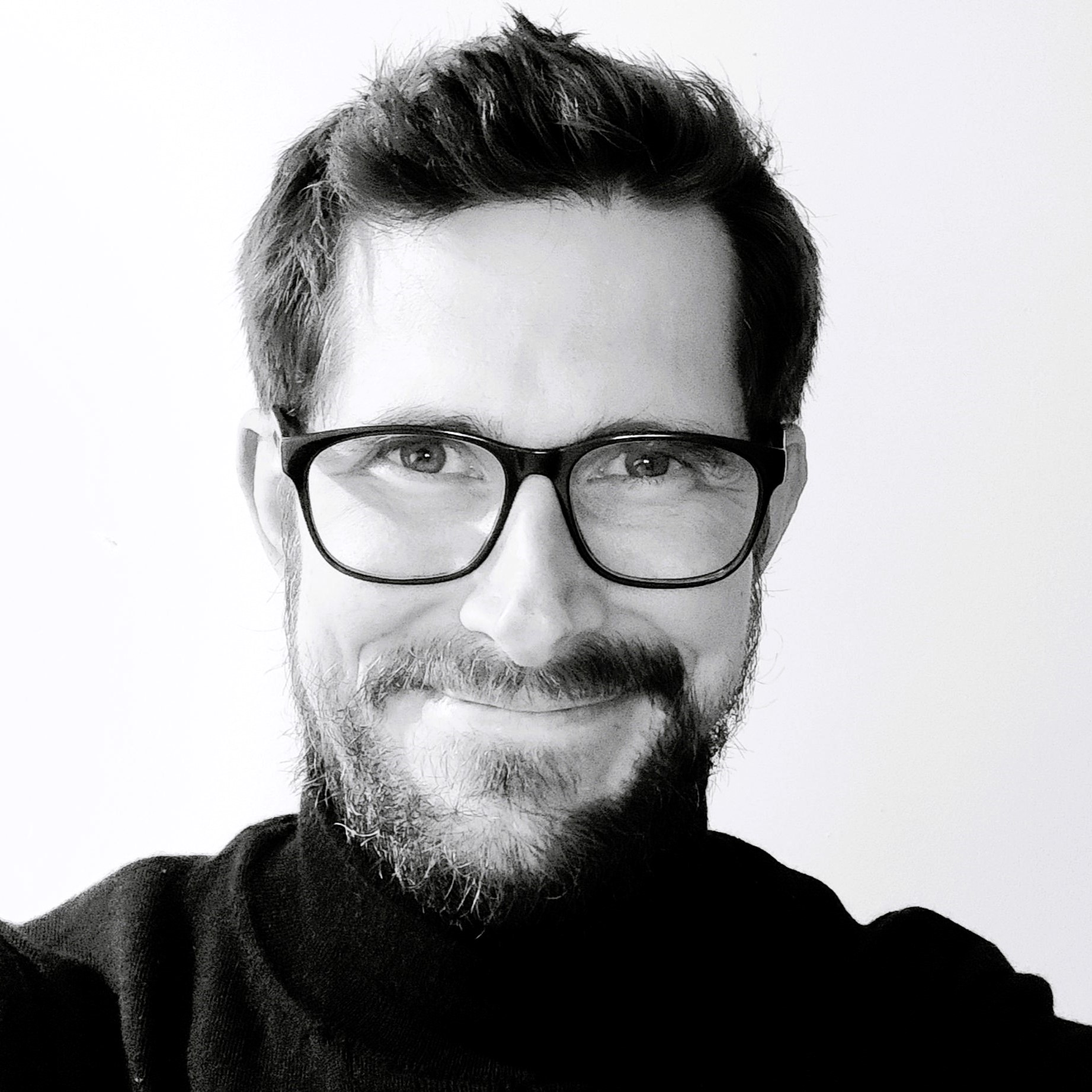
Marcus Link · Who We May Become in a Holistic Future
Marcus Link is a pattern seeker, systems thinker, and writer exploring the intersection of ecology, data, and meaning. As founder of Ecological Intelligence, he develops satellite-based software to assess ecosystem health. A philosopher, cultural critic, storyteller, essayist, and poet, he aims to publish Keystones in the Patterns of Place by the time of this talk.
Watch the recording
Recorded Friday 22 May, 19h00 CEST. The full transcript is available below and as a downloadable PDF.
The full session
Read the transcript
Abstract
In this talk later described as eco-poetic in the audience feedback, writer and entrepreneur Marcus Link previews his forthcoming book Keystones in the Patterns of Place: A Book About the Stories We Tell with Our Footprint. The central proposition is simple and uncomfortable: every living thing has a footprint, so the real question becomes what story we tell with our footprints. Drawing on his work in the regenerative movement including as co-founder of New Foundation Farms and of the agri-tech startup Ecological Intelligence, on his autism (which he reframes as monotropic attention, alexithymia and symbolic-literal equation rather than as deficit), and on a long apprenticeship to writers as different as C.S. Lewis, William Blake, Cecil Collins, Henri Corbin, Iain McGilchrist, Joseph Henrich, Lewis Mumford, Max Weber, Owen Barfield, Tyson Yunkaporta and Friedrich Nietzsche, Marcus argues that imagination, used properly, is not an instrument of escape but the organ of encounter, and that Western culture has lost the faculty of orientation that allows the world to arrive in us in the first place.
He sets out the Tale of Two Tomorrows — the Story of No Story with its map of nation-states, the Story of Another Tomorrow with its map of watersheds and the lifesheds of the natural world — and warns that the Story of Another Tomorrow turns into fantasy the moment it is held up as the alternative to the Story of No Story, because the vocabulary of the Second Peoples then colonises it. He traces a three-thousand-year arc of disenchantment through many intricate details across Western cultural history including Socrates' banishment of Dionysus and distortion of Apollo, the mechanical clock born in 14th-century Benedictine monasteries, and the rise of WEIRD psychology, and finishes with the Compass Rose of Consciousness: a four-fold rose in which east (communion / right hemisphere) and west (discernment / left hemisphere) form the outer axis, and north (Apollo, the bounding of selfhood) and south (Dionysus, transcendence of self) form the inner axis. He closes by locating Smuts on the compass: Smuts the veld boy in the southeast (embodied Dionysian contact with the land); Smuts the statesman in the northwest (Apollonian emissary, drafter of constitutions); Smuts the writer of Holism and Evolution pulling himself back to the northeast; with the whisper from the southwest, the territory of the Fool, where the veld boy who never left him sought articulation.
A long and unusually moving discussion follows, including a contemporaneous greeting from Smuts' birthplace at Riebeek West (Dr Elina Komarova-Tagar), a substantive discussion between Marcus and Klaus Mager on whether the West's destructive trajectory is a human universal or culturally specific, and a quiet exchange with Marc Pierson on participation in groups versus participation from the cave.
Transcript
Welcome — Michael Stock
Michael Stock: Good morning, good afternoon, and good evening, and welcome back to our Centenary Festival of Holism and Evolution. This is Day 3. My name is Michael Stock, and Claudius asked me to say a few words at the beginning and the end of each day. Please put where you are from in the chat, and the question you are holding. Take a moment for that.
I'd like to recap briefly. Yesterday we heard from Jeff Blumberg, and, speaking personally — and I think for everyone — I was so impressed with his long labour of love to understand Jan Smuts over twelve years from his writings. We've had wonderful feedback. I wonder what resonated for you. For me, there were four highlights. The first was that Jan Smuts was looking for an idea of God to replace the supernatural Father — holism as mysticism. Second, Smuts' approach of seeking a kind of synthesis of the deep thoughts of key thinkers, including some of my old friends, from William Blake to Walt Whitman. Third, that what we thought we were going to hear about — the missing sequel — had actually been in plain sight throughout Jan Smuts' life. And fourth, what stayed with me was the poetic — and, I think, urgent — attention to nature's point of view. The Unseen.
Perhaps we might take a few quiet breaths to enjoy and prepare for what comes next.
We are so pleased now to hear Marcus Link, following on so very well from what we heard yesterday: Keystones in the Patterns of Place. Claudius — would you kindly introduce Marcus to us?
Introduction — Claudius van Wyk
Claudius van Wyk: Thank you, Michael. It's a great delight to introduce Marcus. We've walked this journey together for a number of years. In fact, we walked a physical journey, in Italy a few years back, when we shared a space with twelve men on a walk in the spirit of St Francis of Assisi. Together with us was Egon Hus, who is also part of the Holos Earth Group. At that time, Marcus was saying, I'm actually a poet. And wonderfully, out came his book of poetry, Inkblot Moon: The Complete Quantum Poetry. If that tells us anything, we're looking at an amazing, eclectic thinker: a philosopher, a systems thinker, a poet, and somebody with a deep, deep passion for holism, for unity, and for the keyword regeneration. With nothing more needed from me — Marcus, you're on.
The talk — Marcus Link
Marcus Link: Thank you, Claudius. Thank you, Michael. Good evening, everyone. Thank you for coming.
My full given name is Marcus Demetrius Link, and I'm a writer and entrepreneur. I live in the south-west of England, in the countryside, along a narrow and winding lane among meadows and woodland, with my family and other animals, outside Ashburton on Dartmoor. In my life and work, the subjects of wholeness and regeneration are inseparably connected themes. In this talk tonight, I'd like to tether the subject of wholeness to the ground beneath our feet. I want to do that by way of introducing you to a book that has chosen me as its author, and which remains eternally almost completed. It is called Keystones in the Patterns of Place.
In my working life, I came to regeneration through co-founding a company called New Foundation Farms. We pursued an approach to growing food which we called radical natural. Our vision was nothing less than the transformation of the food supply chain from an input-intensive to a knowledge-intensive approach. Sadly, the company closed last year. Today I co-run Ecological Intelligence, a start-up agri-tech company that gives land stewards land-health diagnostics and actionable insights relating to ecosystem functioning, for every field and parcel of their land. It uses satellite and geo-information data in an entirely new way, and it could do that anywhere; for now, we've just started in the UK and Italy. I feel the life inside of me when I'm involved in something radical and big in my own small ways. That big thing, for me, is the regenerative knowledge revolution. Once upon a time, they called that wisdom of the land.
As my time and health allow, I'm also a member of the Holos Earth Project, since Claudius invited me to join in 2020. I'm privileged to have been on quite a journey with him — including, as he said, a real walking pilgrimage with others. Without Claudius, neither this book nor this talk would be here, at least not in this form. He is not just a torchbearer for young Smuts and the much-needed holistic perspective. In my life, he is one of the few people who are able to listen to what I have to say and to hear what I actually mean, even when I don't. In conversation with Claudius, a strange and glorious thing occurs: he allows my own wholeness to emerge in the space between us. My wish is that everyone should have a Claudius in their life.
There are many people without whom this book and I would not be here in this form today. I won't be able to do them all justice, but it won't do not to share my deepest gratitude to Claire, my partner in life, whose loving support, in spite of myself, is a true blessing. And there is everyone on the Holos Earth team: Chris, Egon, Joshua, now also Michael, and Mark van Wyk. My partner in business, Mark Drew. And my kindred creative spirit, Richard Wain. And there's Leon, my son, who is with us tonight, on behalf of the seventh generation, to whom all my work is dedicated.
Salt, and a book of books
The English idiom to take something with a pinch of salt usually expresses a healthy dose of scepticism. Don't take it too seriously, it says. Those who have heard me speak before know that I'm a fan of alchemy. In the alchemical tradition, salt is not associated with scepticism. In alchemy, salt is one of the three principles. Sulphur is the active principle, or soul. Mercury is the volatile principle, or spirit. And salt is the body — the substantial residue, the essence that remains when everything else has burnt away. In alchemy, salt is the ash that holds the living pattern. Maybe you can enjoy this talk as a metaphorical smorgasbord of wild ideas. You can have some salt with it to help with any less palatable ingredients, or to add flavour to the word-soup.
In many ways, Keystones in the Patterns of Place is a book of other books, and a book of questions. One of its questions goes like this: what is it about the story this civilisation of ours, Western culture, tells itself, that has brought us to the sixth extinction event, the climate crisis, and the Anthropocene? My diagnosis is that it has to do with the stories we tell, even when we insist that we are not telling any stories. It is a book about the stories we tell with our footprint — about who we are, what the world is, and what our role in it might be. About what stories do to us, and what we do to the world because of the stories we tell. I come to the conclusion that we have it all wrong about what we think of as story.
I add at least five other big claims throughout the book.
- If we don't have stories, stories will have us.
- The inner stories of a culture and its outer ecosystem are identical over time.
- Before we are colonial unto others, we are colonial unto ourselves.
- Outer regeneration requires inner transformation.
- Imagination, used properly, is not an instrument of escape, but the organ of encounter.
Part 1 of the book sets the scene with me waking up in what I call an imperial cage. This waking up happens with a dream, in which I know that not all is well, but I don't quite know how, and what I'm supposed to do about it, even though I want to. I am complicit in the catastrophe I am witnessing, and I can do nothing about it. It is somehow also my fault, because I am human, because I am alive.
In Chapter 2, I muse on how I was influenced by some of the great thinkers of our time, and how they also gave me a strange feeling. As a child, I grew up in a forest of books. There was no shortage of words, and yet I ended up quite lost. So many words, but not the right ones. Bookshelves are not just full of attempted answers; they are full of the attempted questions that live in us, questions we don't even yet know. Many of the books I encountered were the traces of quests, personal and collective, and I eventually realised it was my turn to pass through the rite of passage — to find myself adrift in a sea of words.
A significant example was my encounter with Stephen Hawking's A Brief History of Time. The infolded starry sky on the cover of the German edition, the narrative, and what Hawking said in an interview about human beings being just chemical scum, evoked a strange feeling. The edge of the universe was very far away and very significant, and I was here, small, somehow a non-entity. The greater my understanding, the more worthless my existence. So, as a boy, I was led to believe the edge of the universe was somewhere very far away. In a universe characterised by separation, it might as well be the most faraway thing possible.
Yet I've come to see the edge not as out there, but as an event that never ends and always begins. I am at an edge — which is the edge right in front of me. It runs right through me. The edge is, because I am. I am the edge. Instead of paling into insignificance beneath the dome of a vast sky, I am relevant to what happens at this edge by the sheer virtue of being here. I cannot prevent leaving a footprint. My breath, my words, my actions shape the world that shaped me. By virtue of my awareness, another level of possibility opens up. I have agency. I want to make something of it. I am an agent at the edge — and that is where, and how, I feel fully alive. From there it ripples out between us, between you and me and all of us, in ways that shape the world.
A photographic plate
My contribution to wholeness comes from my particular way of paying attention. Mine is a pattern-saturated, slow-developing kind of consciousness. It works a bit like a photographic plate. It takes in everything that comes towards it, and is unable to let a single thing be only that one thing. I sit there, staring out of the window, as patterns start to emerge long after the initial exposure. I am an artist.
In my case, autism means I experience the world through what the clinical literature calls monotropic attention — a way of processing in which all my resources are directed into a single channel at great depth. I am also characterised by alexithymia. There is a whole lot going on in me, but I cannot answer how are you today?, because no word or phrase is adequate. But I'll tell you tomorrow, in great detail.
The dominant culture of the Western world understands autism, along with other modes of consciousness, mostly as a deficit, a kind of brokenness. It is true that my way of paying attention is not suited to schools, to employment, or to daylight, and I struggle with most human relationships. But given time, and enough darkness and quiet, my photographic plate starts to work on my special interests. It reveals the structural correspondence between different ways of knowing the world.
Autism is sometimes associated with the figure of the simpleton, or fool. But there's nothing simple about either. The fool is not the figure who has fallen short of wisdom. She is the figure who has not been trained out of it. The English painter Cecil Collins described the fool's mode of direct perception as why-knowledge: the knowing that precedes and survives all analytical frameworks. How-knowledge describes and measures. Why-knowledge encounters and receives. It is the knowing that lives in the leisure of the soul. I have met the fool in many guises, and there is a chapter dedicated to her role in my life, and how refreshing it is to see the world in the ways of the fool. About this way of looking, Collins said: The fool is not a philosophy, but a quality of consciousness of life. She has become to me like the patron saint of wholeness.
Keystones in the Patterns of Place is also a book of convergences across disciplines as far apart as ecology and depth psychology, fractal mathematics and civilisational history. This is enabled through another symptom of autism called symbolic-literal equation. Whilst regarded as a deficit, to my mind it enables seeing what is literal, metaphorical and symbolic much closer together — because I just don't see the separation between them quite the way I'm apparently supposed to. I would encourage people to look more carefully when they think that metaphors and symbols aren't patterns that affect the world.
Maybe the symbolic-literal equation is why, when I read C.S. Lewis' An Experiment in Criticism — an apparently dry book about literary criticism — it turned my life upside down. In it, Lewis says: the problem with books isn't that they are good or bad. The problem is that there are good and bad readers. Bad readers use books, by extracting information that confirms what they already think. Good readers get themselves out of the way in order to receive what is on offer. Lewis believed that reading done well is not a way out of the world, but a way into it. The good reader surrenders not disbelief, but self-assertion, so that the work can do its essential work — to enlarge the self beyond its habitual boundaries. He writes:
In reading great literature, I become a thousand men, and yet remain myself. Like the night sky in the Greek poem, I see with a myriad eyes, but it is still I who see. Here, as in worship, in love, in moral action, and in knowing, I transcend myself, and I'm never more myself than when I do.
It was instantly clear to me that Lewis was describing something far larger than reading books. We don't only read books. We read faces. We read landscapes. We read the stars. We read animal tracks in the forest. We can do all of this either as imperial users who extract, or as receivers who get out of the way so that what is actually there can come properly into existence, making us and the world larger. What if I could read the patterns of life in the same way I can read this book?
Here's another example of symbolic-literal equation at work. During my research for a larger report on the relationship between ecology and economy, I came across two pieces of writing, 158 years apart, on subjects as different as 19th-century literary criticism and 21st-century policy science. To my mind, they're saying the same thing.
One is an essay called The Myth of Regeneration in the August 1860 edition of the New York fine-arts journal The Crayon. Surveying 3,000 years of Western mythologies of regeneration, it finds that regeneration is always hoped for, but never quite arrives. In its own words: "Our hope makes the future a magic cave of happiness, and we think it life's business to discover the open sesame. But we find it a shadow that runs before us, a tomorrow that is never overtaken." The 2018 study traces what happens to agroecology when it meets Western-style national policy. Agroecology in the Global South is a radical social, ecological and political movement, but through the sluggish ways of Western institutions, only the least radical elements are absorbed into existing industrial-agriculture policy. The word agroecology and some of its techniques survive, but its essence is stripped out. The magic cave is the regenerative food system. The open sesame is the word agroecology. Institutions use it as their password. But using the password is not the same as entering the cave. The conditions for entrance haven't been adopted — land reform, food sovereignty, the relationship with the soil. So the cave is always and forever tomorrow. The shadow runs ahead.
That connection is what led me to title the prologue of the book A Tale of Two Tomorrows. From which I'm going to read you now.
Prologue: A Tale of Two Tomorrows
"The question is not what you look at, but what you see." — Henry David Thoreau
It's inevitable: I have a footprint, because I am alive. There's nothing I can do about it.
Once, I wished not to have a footprint. I was so overwhelmed by the devastating impact humans, including me, can have on life and the only known planet of life — Earth. Then one day, it began to dawn on me: I don't have a choice about my footprint, because I am alive. There really isn't anything I can do about it. But there is something I can do with it. There is something I can do with my footprint — with the way I live. This realisation changed my life.
In many human cultures, the soles of our feet are revered as the places where the soul enters the body. It is in fact why sole and soul sound the same. The sole of your foot is your direct connection to the earth beneath your feet. It is where the soul enters you through that embodied connection — and it is that same connection which also leaves behind your footprint.
I have reason to believe that it is not by accident that we use the word footprint as the symbol for the impact we have on the world, and for the essence we leave behind of the kind of life we have led. Like bee and bird through their wingbeat, it is through our feet and our footprint that we are an extension of the land — just as the land is our understanding, quite literally. Such knowledge of our embodied relations with the world, and how they ensoul us, has faded a little from our everyday appreciation. Yet, however neglected, our soul still speaks to us through phrases such as carbon footprint, even if we no longer quite know what it may mean.
This book is about a journey to a place of remembering what it means. Imagine a story written into the landscape by your footsteps. By your footprint. By the way you live. Now read that story backwards, and back to yourself. You'll find there's a parcel of space-time, a segment of the edge of the universe, a niche in the ecosystem, a place in the landscape, a point in your community of life, where you can put your finger on the live wire and feel the pulse of things. Push too hard, and the leaf, the bug, the relationship, the river or the forest might lose its life at your hands. Push too lightly, and you might lose all sense of the weight and relevance of your own existence, and find yourself all separate, disconnected, and lost. How might you gauge the balance point of your finger on the wire? How might you calibrate the measure of yourself — this fine instrument of the cosmos that you are — in this, your small corner of the living world?
Our footprints in the landscape create the patterns of a species that can create more life than it destroys, and that can destroy more life than it gives. There are these species on planet Earth of a kind known as ecosystem engineers. The beaver takes stream and tree to mesh wetland, and hundreds of species bloom in this fabric. The elephant uproots acacia on the African plain, holds the savannah open for grass and grazer, and also predator. Digs dry riverbeds with trunk and foot until water rises, and carries seeds a hundred miles in her dung. The tree grows root and canopy, and is itself the habitat — bark for beetle, branch for bird, leaf-fall for the soil; and underground a fungal web through which the forest feeds its own, tree by tree.
And there are the apex predators. The wolf chases deer across the mountainside. The leopard stalks the impala through the African bushveld. The lion hunts the wildebeest on the savannah. In their footprints, woodland and pasture rise skyward, and a thousand-fold of creatures above and below buzz, swirl, and crow.
There is this farmer in Brazil who stopped feeding his plants and started feeding the soil. He found himself joined by six species of termite who had moved out of the forest and into his fields, where before there were none. And nine species of ant where before there was one — and that one had been a pest. Promoted now to Soil Food Web collaborator. Leaf-cutter ants stopped cutting his crop, and instead took away only fallen leaves. Fungus returned to the soil as helper, having brought a cousin along who now limits devastation by one parasite nothing else can restrain. 244 species of bird have come to nest and feed on this farmer's land. More than 540 species of arthropod. There's puma, ocelot, and jaguarundi stalking through the rows of crops — even the rare Brazilian wolf. Armadillo follow termites; capybara and deer the waterways, where the jabiru stork hunts baby alligator, and the python warms its seven metres of body in the sun. Three hundred-plus species of bird, mammal and reptile on a sugar-cane plantation that yields a quarter more sweetness than where they still use chemicals.
Such species all have a footprint. When their footprints leave behind more life than they take, they are known as keystone species. Keystone species in an ecosystem are like keystones in the architecture of a bridge. In one way, just like all the other stones. In another way, they create entire corners — maybe more — of the universe, teeming with life that would not exist without them.
When I looked at my footprint and compared myself to any keystone being, I found that behind my footprint patterns in the outer landscape, there were hidden two kinds of patterns in my inner landscape. There are two kinds of stories we human beings tell ourselves about who we are, what the world is, and what our role in it might be. I call one of them the story of no story, and the other, the story of another tomorrow. Sometimes it helps to have an image to make something otherwise complex understandable, and I hope the following two maps can help us with that.
Map 1 — the world according to the story of no story
The world as told by the human geopolitics of nation-states.
In contrast to the dominant story of social evolution, not everyone agrees that the modern nation-state is the destination of human history. It may be only a particular, and more recent, blip — some say 250 years in the making, some say 3,000. Seen plainly, the nation-state is the fusion of three forms of domination that, for most of the human past, did not appear together. Sovereignty, or the monopoly of violence within a territory. Bureaucracy, or administrative control of information and populations. And competitive politics, or the contest for authority.
This template has only become universal by sealing off the three freedoms human beings exercised for most of our existence before that: the freedom to move away; the freedom to disobey; the freedom to make a different arrangement somewhere else. Every patch of land now belongs to some state or other, and there is nowhere left to go.
This is how the geopolitical map became the map of the story of no story. The borders, the passports and the census forms, understood not as artifacts of one peculiar, arbitrary and recent political template, but somehow as the natural surface of the planet — as evolutionary inevitability, and the only proof of identity and belonging. And, somehow, quietly, the three freedoms have become footnotes in the story of another tomorrow. Displaced backwards into a primitive past made up of nomadism, tribal egalitarianism, small-scale Indigenous ways of being, romantic idealism. Dream on. That was childhood. We have grown up. But the water and mineral cycles, the solar energy flows, the larger-than-human community, were not consulted. Neither were most human peoples. The United Nations, as currently constituted, still awaits the inclusion of the nations of the Indigenous First Peoples the world over — and the nations and kingdoms of the natural world that make up the larger-than-human community.
Map 2 — the world according to the story of another tomorrow
The world as told by the lifesheds of the natural world and their aquifers and river basins.
Beneath nation-state borders runs another map entirely, drawn not by treaties, but by topography and water. Rain falls on a ridge, gathers into watershed and river basin and ocean floor. On this map, the missing nations appear, at least by implication. The Salmon Nation, the Oak Nation, the Beaver Nation. The Sami, the Diné, the Aboriginal nations of the Songlines, each in its own watershed, each speaking its own dialect of place.
The three freedoms are alive here, in the flows in which water moves, in which soils through plant life gather up sunlight, and life flourishes between river basins below and sunlight above. The freedom to move is to follow the watershed. The freedom to disobey is to answer to the river basin before answering to bureaucracy. To make a different arrangement somewhere else is to find the people of one's own kind and lifeshed — human and other-than-human.
But here is the thing. There is a trap. The moment Map 2 is held up as the alternative to Map 1, it curdles into fantasy. Watersheds turn into administrative units, requiring governance and management layers with policies and hierarchies. Unique lifesheds turn into globally uniform sustainability programmes. First peoples turn into stakeholders. The larger-than-human community turns into ecosystem services. The vocabulary of the second people is wheeled in to manage the alternative. Map 2 is still called Map of the Lifesheds of the Natural World, but it no longer represents an encounter in the unique ways of the unique places that constitute life.
This is why this is a book about how the stories we tell ourselves transform what we see when we look at the world, and how what we see when we look at the world transforms us. When a story captures you, when you are inside of it but do not know that you are, it does not transform you — it uses you. Imagination cut off from the living world becomes fantasy: the projection of needs onto a reality that cannot answer back. When, on the other hand, you stand in right relationship with a story as its teller, rather than its captive, then something else becomes possible. Imagination recovers its older, timeless function: not as instrument of escape, but as organ of encounter. A way of receiving the world and not merely using it.
This book is not a map. It offers a compass to help your footsteps find your way, to help you ask the most existential of questions. What kind of storyteller am I, with my footprint in the landscapes of life? How may my footprint become of the keystone-species pattern kind? How may I become a keystone in the living patterns of place?
The tale of two tomorrows is an invisible bind that imprisons us. Its two stories give us what looks like a choice between right and wrong, but which is which depends on where you stand, and neither breaks through into reality. Both reinforce the imprisonment, and in an uncanny way make it bearable by focusing us not on today, but on tomorrow. Before we are colonial unto others, we are colonial unto ourselves, by the nature of the stories that we host.
Keystone species, on the other hand, are not hosts of stories, but storytellers. Keystone species tell a story about the living world through the way they live, with their life, with their footprint. They are in direct contact with life and the natural world. Their footprint is not a policy framework or sustainability programme. It is an encounter.
The faculty of orientation
To be a storyteller, not a host of stories, requires a particular faculty: the faculty of orientation. Orientation, in this sense, is not about geography. It is about that which mediates our relationship with geography. The faculty that lets the world arrive in us in the first place. Henri Corbin called this faculty the imaginal. Corbin was a 20th-century French philosopher and scholar. He spent his life trying to recover for the West what he called the vertical dimension: the axis along which a human being is aligned with orders of being that the modern scientific gaze has flattened into a single horizontal plane.
It is not that the West disproved this dimension as such. It has just been relegated to the realm of the story of another tomorrow. What counts as real has been redefined in such a way that it now excludes the mode by which the vertical can be perceived.
Most cultures know the vertical, and their relationship with the compass expresses the particularities of their vertical dimension: the Native American medicine wheel, the Tibetan mandala, the Australian Aboriginal songlines that hold direction as song, the four quarters of the Inca Empire, the four sky-bearers of the Maya, the four sacred mountains of the Hopi, the Chinese four symbols of the night sky, the four heavenly kings of Buddhism, the Egyptian four sons of Horus, the four evangelists in the corners of every European cathedral, the four winds of the Maori, the full Slavic.
Linguists who have studied Aboriginal languages, like Guugu Yimithirr, found that for its speakers, the cardinal directions are embodied in their sense of language. To ask someone to move in their seat, a Guugu Yimithirr speaker says move a little to the east, or west, or north, or south, as appropriate. A child of three already knows the cardinal direction of everyone in the room. The compass there is not an outer instrument of navigation. It is an embodied faculty of orientation.
There's a long list of such peoples and traditions who have at their heart the fourfold structure of the compass rose, which represents and mirrors back the lived encounter with the cardinal patterns of the cosmos at an individual and collective level.
McGilchrist and the hemispheres
Iain McGilchrist helps us see how the imaginal realm works at the level of the left and right hemispheres of the human brain. The two hemispheres are not specialised so much by content or function, but by mode of attention. The right hemisphere attends to the world as a living whole. It is open, present, embodied in context, and alert to the new. The left hemisphere attends by breaking the world into parts. It focuses, it abstracts, it names, it readies things for manipulation. Both are absolutely essential. Proper functioning is a three-stage cycle. The right hemisphere engages with the world first. It hands its experience to the left for analysis. The left does its work, then returns what it has made back to the right, where the parts are reintegrated into the living whole. Right to left to right. Whole to part, back to whole. The right is the master, the left is the emissary. When this works, the emissary serves the master, and the world stays alive in our attention to it. McGilchrist puts it like this: The qualities of the world that come to your attention are determined by the qualities of the attention you bring to it.
Corbin mused that Western culture had lost its way with the compass, and wondered when this happened. Three chapters of the book travel back 3,000 years across many disciplines to find out. To cut that journey short, I'll focus on some key examples.
McGilchrist's view is that Western civilisation has become dominated by the left hemisphere at the expense of the right at least three times in Western history. He says: in the case of the Greeks, the Romans, and the post-Enlightenment West, the decline of civilisation has been associated not just with more left-hemisphere ways of thinking, but with forms of military and economic imperialism, and the consequent overextension of administration, a coarsening of values, and a failure of vitality, vision and integrity. McGilchrist calls our current version of this the Hall of Mirrors: a system that can only reflect its own logic back to itself, where every proposed solution reproduces the framework that created the problem. Technology, management and bureaucracy self-replicate, creating more technology, more management, more bureaucracy, and humans end up serving the structures that once served them — with the result that we are no longer capable of seeing intuitively beyond the hermetic world that the left hemisphere has set up, because the capacity to do so has been largely drained from our way of life.
Max Weber, the German sociologist, traced the same arc across three millennia, which he called the Long Arc of Disenchantment: from the plurality of the gods in polytheistic early Greek antiquity, to Western monotheism, to the Protestant work ethic, and on into the age of science. Science, for Weber, is a fundamentally nihilistic exercise, because it has no way of making meaning. It is therefore inevitable that Western culture became increasingly dominated by rationalisation, bureaucratic control and meaninglessness. The crisis of modernity for Weber is a loss of human agency, replaced with an institutional way of life. We have arrived in an iron cage — which is Weber's version of McGilchrist's Hall of Mirrors. To get out, even temporarily, meaning must be willed from within — but this is hard when the cage actually dominates your ways of thinking. It is not only an outer cage. Before we are colonial unto others.
The 3,000-year arc
I don't expect you to read this slide in detail. It illustrates many of the layers of the 3,000-year arc through Western cultural history that I trace in the book. They include: the banishment by Socrates of Dionysus — the twice-born god of regeneration — as the irrational, savage, feminine and demonic. The distortion by Socrates of the god Apollo into the god of rationality, which became scientism, technocracy, the cult of algorithm. The great severance by Plato of the philosophical method from its necessary initiatory grounding. The invention of the myth of universal human progress as a single, linear arc. The secularisation of paradise into progress. The secularisation of the fall from paradise into entropy, progress's twin. The creation of the personal carbon footprint by BP to distract from its own institutional emissions. The conflation of place-based problems with global action.
There are two particular examples I want to share a little more about.
Joseph Henrich is an evolutionary anthropologist at Harvard. His book The WEIRDest People in the World makes a claim that upends a century of psychology. WEIRD is Henrich's acronym. It stands for Western, Educated, Industrialised, Rich, Democratic. His claim is that the people who answer to this description are psychologically peculiar by global and historical standards. Highly individualistic, self-obsessed, control-oriented, non-conformist, and analytical. On measure after measure, they sit at the extreme end of the distribution. It is not a normal kind of psychology in human terms. Most people who have ever lived have not been like this.
The reason is to be found in our institutionalised way of life. One example: the medieval Catholic Church introduced a programme of marriage prohibitions from the 4th century onward, banning cousin marriage and dismantling clans. Over a millennium, dense kin networks were replaced by smaller nuclear families. From those families came the guilds, the universities, the impersonal markets. Henrich also unearths what amounts to a psychological scandal. He shows that 96 per cent of experimental psychology has been drawn from European, North American and Australian WEIRD demographics. Seventy per cent of these are American undergraduates. The data we have used to make generalised statements about human psychology comes from people who, on the global distribution of psychological traits, don't represent the species. They are the exceptions we have mistaken for the rule.
The mechanical clock, Lewis Mumford wrote, is the mother of all machines. It was born around 1330 in a European Benedictine monastery, to enforce the seven daily offices a monk could not miss without sin. The clock made the rhythm of devotion exact. Hours became fixed in length for the first time, and separated us from the natural rhythms. Qualitative seasonal time became uniform, metronomic time. Once invented, it spread across 40,000 Benedictine monasteries in no time at all. Each one connected mechanical clock and bell tower, synchronising not just the monk's routine, but the communities around them, with a beat of institutional time. Soon the clock left the cloisters, and bell towers spread across the town squares of Europe. The timepiece — one of the greatest jailers of human agency — moved into pockets and onto wrists as the prosthetic organ of time. It was not the Enlightenment that brought about the scientific revolution, but the mechanical clock, that rewrote the story of the cosmos. The universe became clockwork. The body became machine. This is left-hemisphere dominance at work, expressing into the world its own abstract vision. And once out there, it's obvious that time is a constant — though it had never been one before. This is an example of what McGilchrist's Hall of Mirrors means.
Then, with the Reformation, the discipline of monks was universalised, and became known as the Puritan work ethic. Time became morally weighted. Punctuality became a virtue. This is what Weber means by iron cage. Hard time becomes hard currency. Time thus monetised hardens into factory floors, where with Henry Ford, labour was reduced to selling soul-time for ever less rewarding work. Consumer debt inverted what was once a virtue — to be frugal, to be free, to need little — into a sign of failure, of insufficient ambition, of not being fully civilised. The clock deeply shaped the WEIRD self: individualistic, control-oriented, time-disciplined. In the book, I say that we find ourselves wearing a straitjacket made of mechanical time. We know what time it is, but we don't know what time is.
First, Second and Third Peoples
With all this weight of 3,000 years bearing down on our shoulders, what are we to do?
Tyson Yunkaporta is an Australian Aboriginal scholar. In his book Sand Talk, he uses the Western trick of generalising things that are really unique. In this case, he generalises humans into two types of peoples. First peoples, he says, are Indigenous cultures with unbroken continuity with the land. They live by First Peoples Law, under which nothing is created or destroyed, because of the infinite regenerative connections between systems. Time for them is non-linear; it turns in cycles. The world renews itself.
Second peoples, he says, are civilised, city-building cultures: communities that consume everything around them, and then themselves. They live by Second Peoples Law, which is a misrepresentation of the second law of thermodynamics applied to the open systems of life. The result is decay. Then entropy is used to explain the decay, as the world around desertifies.
Yunkaporta also says that it's not about ancient knowledge, but about ancient ways of paying attention. He is clear that second peoples are not second peoples by destiny. They are second peoples by amnesia. The land is still under their feet. The knowledge is freely available. The crisis is not the end of human capacity to belong to a living world. It is the symptom of a culture that has forgotten how to.
Anyone who has taken the first fumbling steps towards being part of a custodial species — in my book, I call them third peoples. Third peoples are those who have passed through the left hemisphere's analytical world and recovered participatory consciousness on the other side. They carry the gifts of the analysis with them, but integrate that into a new encounter with a living world. Owen Barfield called this final participation. Final doesn't mean destination; it means the kind of participation that depends on the will and choices made by individual human beings, and on the kind of thinking that has come to be called imagination. Not an impossible return to First Peoples participation. Not an improvement on Second Peoples non-participation. But a new direction of travel.
Imagination and orientation are notions that keep turning up in the many different accounts of what we have lost in the historical and cultural arc of the West. I said earlier that this book is meant as a compass, and not as a map. Chapter 12 is about how the imaginal realm brings together the inner and outer sense of direction. It attempts to answer: how, as third peoples and aspiring keystone species, might we navigate with our footsteps in the landscape of life?
The compass
Imagine yourself outside, in your favourite hideaway in nature, far away from fellow humans and light pollution. Take in the light as it changes through the day. Sunrise. Noon. Sunset. And then the dark of no sun at all, maybe illuminated by starlight and the moon.
The seasons turn around you. Temperatures rise and fall. The rains come and go. The wind shifts direction and quality. Animals and plants emerge, stay a while, flower or graze, retreat. You become part of the perturbations of the year. The patterns of the living world flow through you. You look to the night sky. The patterns above shift with the night and with the season. You begin to see patterns among the stars that carry the quality of the patterns around you. The patterns in the night sky are no longer just stars. The star-symbol patterns above converge with the patterns below. Each one waxing and waning with the moon. They begin to merge with your sense of inner and outer patterns — of dry and wet, of warmth and cold, of light and dark, of plants and animals, of meaning and purpose.
Countless cultures describe, in varying ways, the ever-same four cardinal modes of bringing consciousness to bear without even trying. These poems and hymns and rituals used the compass rose, and the four times a day, the seasons and the stars, to describe them.
- In the east, the direction of the morning sun: the communion with the interconnected outer world, and the field between things.
- In the west, the direction of the evening sun: where things have shadows and contrast — the discernment of the essence of other things, as things in and of themselves.
- In the north, the direction of light in the dark, of moon and of northern lights: the inner experience of selfhood, of eternity, of timelessness.
- In the south, the direction of the full sun at midday: the inner experience of the transcendence of self, of oneness with the world, of regeneration, and of the cycle of rebirth, of life and death.
Our left and right brain hemispheres now find their place on the compass as the axis of outer knowing — of brain structure that perceives world structure. The east of sunrise and communion is the master: the right hemisphere's mode of beholding the whole, of embodied knowing, of presence, and of integration. The west of sunset and discernment is the emissary: the left hemisphere's mode of discerning the essence of things, of naming and articulation, of serving the whole.
There is another axis on the compass. It runs from north to south. It is the axis of the inner phenomenon. For this I reach for the final book in my book of books — Friedrich Nietzsche's treatise, The Birth of Tragedy. It describes, so rebelliously and awkwardly, but so accurately, what we lost with Socrates. What Nietzsche glimpsed under 3,000 years of clutter was that regeneration occurs between the gods Apollo and Dionysus before their distortion and exile. Apollo, before he became god of the light, was once known as the god of darkness and of dreaming. And Dionysus, before his exile as the devil, was known as the god of abundance and of regeneration.
- In the north, the darkness of night: Apollo finds his light of selfhood by descending into the darkness.
- In the south, the full sun at midday: Dionysus, the twice-born god who embodies the union of woman and man, revels in life's abundance and fullness.
The one brings to wholeness the transmutation of order into beauty: the bounding of selfhood, articulated wisdom. The other brings to wholeness the transcendence of self into the boundless nature of the world: dissolution, ecstasy, embodied knowing. They go together like cup and elixir.
And you stand there, in your favourite hideaway in nature, with your bare feet on the ground — at the meeting place of left and right hemisphere, and of Dionysian wildness and Apollo's gift of order. Enfolded as a keystone into the patterns of place. What anchors the winds and the stars, the four times of day and the seasons, your four ways of knowing yourself and the world? What anchors all of this is the thing we call just stories — the stories you tell with your footprint, simply because you're alive. The stories you tell about who you are, what the world is, and what your role in it might be.
You stand there at the centre, where the two axes cross, in the enlivening field with the live wire of the polarities running right through you. Here is your parcel of space-time, your place on the edge of the universe — a wholeness made by the world that in turn makes the world whole.
You feel the pull of each direction to its deathly edge. Apollo without Dionysus becomes the rigid self — the unyielding identity, the iron cage of self-importance. Dionysus without Apollo becomes mass ecstasy — the cult, the dissolution that loses everyone in everyone else. Emissary without master becomes the lifeless algorithm — the dashboard, the sustainable development goal. Master without emissary becomes a dream fog, mystic murk, undifferentiated awareness without articulation.
Your imaginal work of orientation is to hold the course of the living centre, with all four directions in conversation.
Smuts on the compass
There's not enough time to go into more depth. I could show you how the compass faithfully shows the orientation of anything humans have ever said or done — from music and food culture to philosophy, and so much more. So let me just show you an outline of the life of Jan Smuts.
Smuts, the veld boy, growing up in the bushveld of southern Africa, sits in the southeast: the embodied, receptive contact with the wildness of the land, his body open to the cycles of place. There is no doubt that this is where the seed of holism took its embodied root — between the right hemisphere's contact with life and the Dionysian depth of his experience.
Smuts, the statesman, is at home in the northwest, in the Apollonian emissary mode: as architect of constitutions, drafter of the preamble to the United Nations Charter, wielder of bureaucratic authority.
Smuts, the writer, pulled himself back towards the right hemisphere, tending northeast to write Holism and Evolution. The book that articulated what he knew deep inside from his days as the veld boy, bridging it into the idiom of philosophy and science so that he could be heard by his audience.
My guess is that it would have been a whisper from the southwest of his compass — where the embodied Dionysian encounter of veld, still living in his bones, sought his skill of articulation to complete his full geometry of wholeness, and thus give holism to the world. I am certain of it, because the southwest is the territory of the fool. Where we can no longer jump over our shadow, we have to step into it. Step into the darkness and own our brokenness, to make ourselves whole. The southwest is where we can no longer live with the state of things — where we can no longer live in this relationship or this community and close our eyes to what is going on.
The real health of life is not a state of ideal functioning. It is the attention paid, by the adequate diversity of living creatures, to the issues of wholeness that necessarily exist. And in attending, wholeness forms. The psychologist Marie-Louise von Franz said about this simply: it has to be done with the way one lives, not just with the way one thinks.
And we are left with nothing but this burning question inside: How may my footprint become of the keystone-species pattern kind? How may I become a keystone in the living patterns of place?
Enough talking from me. I am going to hand it back to Claudius.
Response and discussion
Michael Stock: Glorious. Before I try to add a few words — how would you like to deal with the questions in the chat, Claudius?
Claudius van Wyk: Let's have the silence, and then we can look at that together.
Michael Stock: Thank you. The invitation is — because we have heard from Marcus such an extraordinary story — may we take a deep moment of silence, please. Half a minute. I'd like to make it a minute, because I am still feeling this. One more deep breath. I needed that. Thank you, Marcus.
Claudius van Wyk: Marcus, when you describe yourself as a poet, your presentation was poetic. When you describe yourself as a philosopher, your presentation was philosophical. But back of that, there was a deep systemic thinker — not only in the right brain, but also having the proper dialogue with the left for implementation, in the way you use technology. This encounter with you has been intriguing, because it follows the presentation of Jeff, who yesterday bridged the gap that Smuts was addressing — from Smuts' problems with the world he lived in, to a new open space, a paradigm shift of consciousness. He bridged the gap that was described in Smuts' history by Professor Du Pisani. What you've done here is you've actually served to bridge the gap between Phase 1 of this festival and Phase 2 — which is going into the liminal space. Which is going into the space of remembering. Which is going into the space of addressing that amnesia you spoke about. When Smuts said that we want to see nature through her own eyes — that's what you were talking about. Being in that one deep evolutionary process.
We'll formally thank you afterwards, but we're going to open the space. There are some very interesting questions and observations in the chat box. We'll see how to work with those — but we're just going to open this to anybody moved to respond right now, from your heart. Mark and Tarryn.
Mark van Wyk: Well, I think it probably will be combined, because I am speechless. I just wanted to say that that was phenomenal. So much thought-provoking stuff in there — thank you so very much, Marcus, it was absolutely amazing. I screenshotted so many of your slides. You also had me at — what is the word that I had to go and look up again to show Mark? — alexithymia?
Marcus Link: Alexithymia.
Mark van Wyk: Yeah, yeah. Mark will often say to me how are you feeling? and I'll be like, okay. So maybe that's something I need to look at. Blind to the emotion — I can't quite express it, I can feel it, but I have no way of explaining it. But thank you so much for sharing that wonderful presentation with us. I'm really feeling it in the soft and tender bits. I do have a question, though. Very interesting, the left–right axis — very clear to me what the roles are: the analytical and the creative, if those are two bland words I can put to it. But the north–south is kind of new to me. I was trying to make notes, but by the time I was ready to write it down I lost it. I wrote down Apollonian and sacrificial, but I don't think I did it justice. Could you just touch on a sentence or a phrase for each one?
Marcus Link: Going back to Apollo and Dionysus — my intention is not to overwrite, or write out of history, any other culture. What I'm trying to do is focus on the West and go back to the roots of Western civilisation, and recover what became distorted there. The very basic way to understand Apollo and Dionysus is that Apollo is the inner realm of being a self, and going through a life and becoming more and more aware of one's own identity in the world. And Dionysus, on the other hand, is our engagement with the world in such a way that we, as Lewis puts it about reading, transcend ourselves, and yet are never more ourselves than when we do.
This is a total polarity. Apollo and Dionysus don't get on with each other at all. On the Greek stage, in the original theatre, there is the choir with the masks on, and there are the heroes acting out the play, and they have a bit of a thing with each other — but it's the dialectic between them, the engagement, that, just like the left and right brain hemispheres' interaction, leads to a wholeness. Apollo makes the cup, and Dionysus pours the wine. You can't drink without the cup, and you'll go thirsty if you don't have the wine. I'd like not to nail it down to specific words, because then you go back into the trap of the Western world of okay, I know that already, I've got a list on my dartboard. But no — it's an inner experience of selfhood, and the transcendence of self, at the same time.
Claudius van Wyk: Thank you. Dr Elina?
Dr Elina Komarova-Tagar: Am I here? I would like to bring you an echo from a very southern hemisphere — the compass rose, which we feel here in a very specific way. If you are looking at the direction of north and south, with the southern axis, Earth is slightly shaking as it is rotating. Last Sunday we were attending a parade at Smuts' birthplace at Riebeek West, and there will be a parade and Memorial Day held on the 24th, this upcoming Sunday. So I would like to send you greetings from Jan Smuts' birthplace.
Marcus Link: Thank you so much.
Dr Elina Komarova-Tagar: From that very root of the serene years, which we all observed and venerated with the friends, veterans and some of his family. I send you that light and greetings — and more to communicate in the future, after that salt will be dissolved into soul-space and sulphur. But there's already some sulphur coming up to you. Our alchemical greetings to you.
Marcus Link: Thank you. Alchemically received.
Claudius van Wyk: Jeff?
Jeff Blumberg: Marcus — one word: wow. This is when you have to take a deep breath and absorb what you said. It's incredible. It's almost like Smuts. I don't know how old you are, but you're not as old as I am — and for such a young mind to absorb what is going on in that way is incredible. Just like Smuts was incredible at the young age that he was, when he was looking for a new idea of God. You're looking for a new idea of life. Equally incredible. Well done.
I have a couple of comments. I hear Blake, especially when you talk about imagination. I hear Blake and Smuts, of course, because Blake influenced Smuts in a very deep way. You said — I wrote this down — imagination is an organ of encounter, receiving the world, not using it. That's very profound. And that is very Blakean. You said thinking that has become imagination. That is deeply Blake again. Are you drawing this from a reading of Blake, or are you just Blake yourself?
Marcus Link: Very beautiful, thank you — very high praise. The way I'm constituted has meant that I've read certain books many, many, many times. In fact, Lewis says the way of the good reader is that you go back to the same books over and over again, and every time it's a new book. You'll know that experience, as you've been reading one book, more or less, for twelve years. I've always been drawn to things that reflect something of me — and I think that's true for all people. We're drawn to things that reflect us, and it's the other way around: that which we encounter is also that which reflects us. I can't answer your question directly. I can only say that it's taken me a lot — I'm 47, and when I was 8, I decided I was a writer. Alexithymia and monotropic attention mean that articulating the ideas I had when I was 8 is only just starting now. So I'll think about your question a bit, and when I have a better answer, I will tell you.
Claudius van Wyk: Thank you. Klaus.
Klaus Mager: Great job, Marcus, to summarise this — because food and agriculture is also my space, that I've been spending a lifetime in, and I'm much older than you, for sure. The more you learn, the more aggrieved you are. But I wanted to point out that the pathologies in our food system are not unique to the Western world. Historically, it's a recurring phenomenon. Think of ancient Mesopotamia, which destroyed its soils — one of the most famous examples, in the Tigris floodplain. Without adequate drainage, the soil became saline. You have Easter Island. You have the Mayan culture that vanished. There are many examples throughout history where civilisations that were incredibly successful vanished, because they could not feed themselves any more, because they had destroyed the environmental conditions to grow food. Particularly during periods of growth, an intensification of agriculture resulted in surplus food, which allowed populations to grow, and then it collapsed. We are in a phase today where there is really nothing new about it. The only difference now is that it's global. Before, with the Mayans, it was one region that destroyed its capacity, that destroyed the capacity of the soil to carry a human population. Now it's global. That makes it rather scary.
Marcus Link: I think that's a very pertinent point, and I agree with you. And I disagree with you. I agree with you that there are many cultures that have taken this trajectory. And I also disagree, because there are some cultures who did not — but they were nonetheless subsumed by cultures that do, because cultures that exploit their soils become colonial. They have to go elsewhere, if they can, in order to subsume other peoples and their land.
If you look just at two examples — the Hawaiians and the origins of slash-and-burn in the Amazon. The origin of slash-and-burn in the Amazon is not to fell all the trees and create grazing land for McDonald's beef burgers. The origin of slash-and-burn is a very careful regenerative system with a fourteen-year rotation, in which trees are felled and burnt in order to give carbon to the soils, which in the Amazon are very low in carbon. You grow for a year or two, and then you move on, and thus you create a cycle of fourteen-year rotations that sustained peoples for a very, very long time. I think it's a danger of the Western mind to try and generalise all human peoples into the same trajectory that is ours — which is absolutely wrong and dangerous. So I agree with you. But I disagree with you, because you need to look at examples of active, positive, successful regeneration over hundreds of years of peaceful existence. There are so many examples that don't exist in our history books, and this is why I gave this talk — because we need to look outside of the Hall of Mirrors that we are enclosed in. Otherwise we are not holistic. But I also agree with you, Klaus.
Klaus Mager: One argument doesn't preclude the other. We're talking about Indigenous wisdom, about Indigenous cultures who have perpetuated their relationship with nature. Well, Japan is indigenous. They've been on the same island for 4,000 years, and they've been able to —
Marcus Link: Today's Japan is not indigenous in the way I talk about indigenous, but we should have a long conversation about this.
Klaus Mager: Let me finish my sentence. The Japanese have been able to — now that they are diverging from their indigenous roots is a different story. Look at Europe. You have Italians, Spaniards, Germans, and so on. All of these cultures have lived on the same soil for hundreds of generations and survived. Today, with the introduction of industrial agriculture and petrochemical fertilisers, we have put ourselves at risk collectively.
Claudius van Wyk: What we're going to be doing when we go into the liminal space, where you'll be speaking, Klaus, is looking specifically at these issues, and dialoguing so we can learn together. Thank you for that encounter. Mark — Marc Pierson.
Marc Pierson: Marcus, it's so good to see you again, and like most people here, I can't even begin to tell you how much I appreciated your talk. It was truly amazing. I'm sitting here trying to process it, and I find myself wanting to make what's probably about a two-degree shift in one of your four directions. I'm lazy, and I want you to do it for me at some future date. I'd love to hear the same talk from two degrees over that's about participation in groups. The way I listened to your talk — I'm not painting this on you — the way I listened was one of amazing synthesis and revelation of you, the person. And I'm very interested in your similar talk on when it's a group. I don't need you to do anything now — you can respond if you want — but I find myself trying to do that translation, and thinking maybe I could just get Marcus to do it.
Marcus Link: I don't think I fully understand. The response that comes up in me is — I'm a creature of the cave. I'm not a creature of groups. If anything gives me the heebie-jeebies, it's the idea that I'm going to be part of a group. I can do it, but it costs my nervous system a huge amount, and I pay the price for it later. My natural refuge is the cave in darkened light, where I join the inner world, which is where this kind of thing happens. There's a huge gap in my life in terms of my ability to translate into the space with other people.
Marc Pierson: That's completely fair, and you and I share that more than you might imagine. Ten years ago, I heard myself, very surprised, saying in response to a question about what I care about: freedom and solidarity. I had no idea what it meant, and it took me ten years to figure out that and was the key word. Another three or four years turned that into participation. So what I'm really curious about, after listening to your talk — and I hope I'll listen to it and read your book a few times, because I'm slow in the same way you are — my ethical stance in the world as a 76-year-old is: how can participation be less problematic and more life-giving? It's clear that I have to do my own homework, and I can't get you to do it for me.
Marcus Link: I might change my mind on this as I get older, but having got to this place, I feel that this is, at the moment, the participation I can offer. I take it that my voice has been heard, and that I've done the work of bringing something together and communicated it in such a way that it has sent ripples out. And it's those ripples that actually make me a participant, though I'm doing it from my darkened cave. That, to me, makes me feel part of something nonetheless. But it's probably not the participation you're talking about.
Marc Pierson: That's a perfect answer. I, too, do almost everything that moves me forward in a cave, and then I step out into the real world and try to get back to my cave as soon as I can after a day in the emergency department. Thank you for everything.
Claudius van Wyk: Thank you. And I know your passion, Marc, for relocalising creativity and the group. It's going to be definitely part of our inquiry in the liminal space. With that, I'm going to go to Benita.
Benita: I'm in another deep south. I'm in Johannesburg in South Africa, just down the road from where Jan Smuts lived. I'm profoundly moved, and as everybody else has said, I was completely speechless, and not sure that I was going to be able to find the words. But I do feel compelled to find the words.
I've followed two — I was going to say parallel, but perhaps divergent — tracks in my life. One has been the hard scientific route. I worked in a research institution for many years over the past twenty years. Before that, I worked in the environmental field for a long time. At the same time, because that was so very hard, I followed a different track where I volunteered in wilderness, nature-reconnection kind of work. I trained in science, but I don't consider myself a scientist. I just wanted to say how hard the journey through the scientific way is — how immensely difficult it is — and how deeply moved I am by this poetic and eco-poetic presentation, of a new kind of way of looking at things.
It's a balm. It's an absolute balm. It's given me real hope, in a time where — I lost my job seven months ago because of this kind of hitting-a-brick-wall, hitting-a-concrete-barrier, not being able to break through with the people I worked with, because of this strong left-brain orientation. So it's very, very real. I feel you've opened a new window. I also read a lot — and I have not come across this particular eco-poetic way of looking at things. I found the reference you made to the way that agroecology has been diminished in policy incredibly painful. I've also been working in the food system and regenerative-agriculture space for a while. Very deep gratitude, from my heart and soul. I'd really like to have further conversations.
Marcus Link: Thank you, Benita, and I'm sorry about the brick wall you hit. I hope that, when you look back in the future, it will have been the best thing that ever happened to you. Maybe you're on the way. I send you lots of love for that journey.
Claudius van Wyk: Dr Elina, did you want to come back in again?
Dr Elina Komarova-Tagar: Yes, if I may. Something I would like to come back with about that footprint on Earth. I work with elderly people in a holistic way of medicine, for more than 30 years, and have the privilege to accompany them in the final stages of life and in the final days of life. With your presentation, I will take it to my future meditation — that footprint. Though we have to shake the dust off our feet, yet when we are ascending, we take the imprint of the Earth into the higher spheres. With the elderly, with that transparency — or severely sick people, when they are already disembodied and become childlike in their bodies before they depart — yet very often, it will be that hardness on their feet which also indicates, once again, what you were stating. It is an Earth-binding organ of ours. Which, once softened, can give us that ascension. Yesterday we were celebrating in Orthodoxy the ascension of Christ, and I would like to send that to you as well, from South Africa.
Marcus Link: Thank you very much. What a beautiful thought. I'll take that with me.
Claudius van Wyk: As I look at the screen, I see a number of the speakers who are going to be presenting into our liminal space. The next speaker is Dr Glen Martin, who's going to be looking at our governance systems, very much against the background you described, Marcus. We have Dr Anthony Turton, who's going to be looking at the watersheds you spoke about. We have Klaus, who's going to be looking at our food systems — and that sounds like it's going to be a lively debate, and so it ought to be. We're going to be looking at our employment of technology. We're going to be looking at the human footprint in our built habitat. That's all part of the next phase. We call it the liminal space because we're going to allow space for the right-brain processing to inform us again. You've built the bridge.
Marcus Link: You've put such a beautiful festival together, Claudius. I know it's lots of people, but you've carried the weight for this. And just as you say that, I get goosebumps from how it all fits together. Beautiful.
Claudius van Wyk: Any closing comments before we close off? Anything that's just on your heart. Yes — Richard Wain.
Richard Wain: This is, in a way, it feels like it cuts against the conversation, but I think an important comment in the chat from Mark: is Marcus's book available as yet?
Marcus Link: I wish it was. I'm still in the process of finishing it, and I decided to give it its own time. But I do hope it will be this year. I'll ask Claudius to share it with the group of people who attend, once it has crossed the line.
Claudius van Wyk: Absolutely.
Jeff Blumberg: Are you saying, Marcus, that the book chose the wrong author?
Marcus Link: Maybe. Maybe.
Jeff Blumberg: I said that because of your own expression — I thought that was very profound.
Marcus Link: Ursula Le Guin, in The Earthsea Quartet, describes how the mage, as Ged, gradually grows up. At some point the master patterner speaks to him and says: as we grow up, we think we have a hundred paths that could be ours, but as we grow older, we realise that it's just the next step that we take. This book is one word at a time, gradually coming together — so it's actually a joy to only have that, a narrowing of life to just the things that really matter. I may be the wrong one, but it really matters.
Claudius van Wyk: We will promote that book, just as we'll promote Jeff Blumberg's book on Smuts when it comes out. Andrew?
Andrew Cameron Bailey: Well, how's it, everybody? Young man from a place called Durban — you probably have been to. And Berry Behr, it's good to see your beautiful face, my dear. Claudius — you showed up in my friend request on Facebook this week, and I hadn't heard of you before, and I didn't know your relationship with Sunrise Ranch and the Emissaries of Divine Light. That's how I came to be here. When I looked at this, I saw that our dear friend and colleague Jude Currivan is on tomorrow, as is our other dear friend and colleague, David Lorimer — and I realised this was family. It took me forever — I missed this whole talk, I just came for this after-chat. I showed up in time, I just couldn't quite find it.
I'll tell you a brief moment of my history and how it relates to Jan Christian Smuts. I was three years old in 1947, when my family emigrated from England — I was born in Coventry — to South Africa. We arrived in 1947, pretty significant time, because things were just about to change radically in our beloved country. The depth of Jan Smuts is not something I was aware of, so this is very new to me — to meet all of you scholars who really know what he was about. My wife — who Berry knows very well — and I are in the field of consciousness and conscious evolution. I have a brand new book coming out, by the way, Berry, called Holo Sapiens. I'm giving a name to what we have to become: from Homo to Holo. Let us become true, integral, awakened humans, and behave differently. That's my fundamental message. So it's good to be here, and I will be here tomorrow.
Claudius van Wyk: Thank you so much. Nnaemeka.
Nnaemeka Prince Akano: Claudius, thank you. Just like Andrew shared, I didn't join the talk by Marcus, but I came on board when the accolades were all coming through, and I could hear that it was quite a satisfying engagement. It is said that the reward for good work is more work — and Marcus, I am deeply inspired in my heart, speaking from Krakow, Poland, where I live and study, to suggest to you a little bit more work to do. That could be in the form of taking me up as your scholar. I would like to be mentored by you, if you so commit.
Marcus Link: That's a very wonderful thing to say, and I'll take it with me. Thank you for the question — there's something there that I won't respond to now, that would be well considered.
Claudius van Wyk: Excellent. Remember that all of these recordings will be available — just email us, and we can make all of the material available. It feels as though we're just about there, unless there's a last observation.
Egon Hus: Yes, can I say something, Claudius? I was so intrigued, I just wanted to share this with Marcus, and go back to the pilgrimage we walked together with you, Claudius, also. I remember when we were walking into some medieval town, and we were talking about your poetry, Marcus. At some point I just said — just put it out there. I'd like to remind you that with your book that you are writing — tonight you basically already gave birth to your book in this community. It's already there. Just get it out there. Thank you so much for your wisdom. It was so much more than a presentation. I still don't have the words, but we'll get back to that. Mesmerising.
Marcus Link: Thank you.
Closing
Michael Stock: Thank you, Claudius. If I may just say one or two words about what Marcus brought to me. To refer to Benita's wonderful phrase of the eco-poetic, it was like a waterfall of eco-poetry. Thank you so much. The pace of it meant there was so much to think about. I want to go back to our first day, and what I learned from Professor Kobus du Pisani, where we learned of Smuts seeking to bring necessary hope in a post-Great-War age of anxiety. Well, the world we are in now is anxiety plus so many other words we might want to add. I was heartened by Jeff Blumberg's reference to nature's view, because for many of us, that gives us hope. But I am still sitting with the breadth of the wisdom, Marcus, that you referred to. You ended briefly on Nietzsche, a writer I know a little about, who was writing 100 years before Jan Smuts. The question I am sitting with, really, is Nietzsche's reference to the last men. Which is very sombre. Which is why I'm so grateful, Claudius, that we can look forward, after this weekend, to transitioning to the liminal space — where we might have more time, in great company, to ask the questions we are all holding now.
Tomorrow starts much earlier, so for anybody who's thinking they'll just tune in at the same time, at the same place — you'll be a little late. Particularly for anybody hoping to join from the West, it means the alarm clock, or birdsong, because tomorrow begins at 10am Central European Time. We love to see you there. We'll start at 10 and run through the morning. We'll hear from Dr Jude Currivan with A Unitive Vision for Humanity, and from David Lorimer on Inwardness and Agency in the Evolution of Consciousness. After that, Claudius will be in dialogue with all of the presenters. A very rich morning — I think you need a packed lunch.
Claudius van Wyk: I just want to say that I forgot to mention Dr John Anderson, who's a palaeobotanist, who will be with us also later in the series. Thank you so much. And good evening.
[Note: Marcus's slides did not display for the first few minutes of the talk. After several attempts to resolve the issue, the slides appeared from the Radical Natural slide onwards, and Marcus continued without re-doing the opening. The technical exchange has been omitted from the transcript above.]
© 2026 Claudius van Wyk. All rights reserved.