Centenary Festival · Phase One · Wednesday 20 May
The Upward Path of The Universe
The Significance and Origins of Holism: Jan C. Smuts
Professor Kobus du Pisani · The Origins of Holism
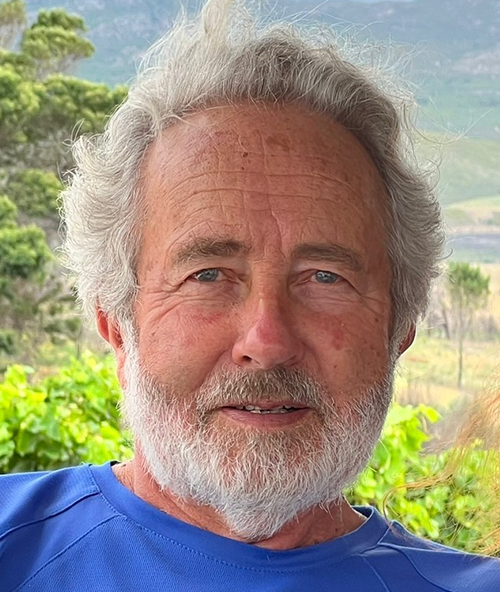
Professor Kobus du Pisani, one of the foremost scholars on Smuts, will anchor the opening program by setting Smuts' life and work in historical context. Prof du Pisani is editor of "Jan Smuts, Son Of The Veld, Pilgrim Of The World".
Watch the recording
Recorded Wednesday 20 May, 19h00 CEST. The full transcript is available below and as a downloadable PDF.
The full session
Read the transcript
Abstract
In the opening session of the Centenary Festival of Holism and Evolution, Prof Kobus Du Pisani — chief editor of Jan Smuts: Son of the Veld, Pilgrim of the World (2019) — sets Smuts' 1926 book in its biographical and historical setting and argues that Holism and Evolution should be read as, above all, a deliberate message of hope addressed to a Europe in the grip of post-war pessimism. He traces the roots of Smuts' optimistic outlook (a devout but unconventional Christian upbringing influenced by the Quakers; Cambridge in the 1890s and the era's "great idea of progress"; teleology after Kant; Darwin and Bergson; Einstein); the European zeitgeist that swung from la Belle Époque through the Great War into the "age of anxiety" of Spengler, Freud, Valéry and Berdyaev; and Smuts' own political eclipse after 1924 (the Bulhoek Massacre, Rand Revolt, Bondelswarts Rebellion, and the Pact's election victory) that gave him the time and motive to return to his earlier holistic manuscripts.
He then walks through Chapters 10–12 of Holism and Evolution — personality as the highest expression of holism, the ideals of creativeness, freedom and purity, and the "friendly, holistic universe" — and closes with six ways the book gives expression to Smuts' optimism. A wide-ranging discussion follows on mysticism and the sentient universe, what Smuts might say today, Smuts as the veld boy versus Smuts the statesman, the relationship of nature and inwardness to his thought, and what "personality" actually meant in his vocabulary.
Transcript
Welcome — Michael Stock
Michael Stock: Good morning, good afternoon, good evening, everyone. A warm welcome to our Centenary Festival of Holism and Evolution. My name is Michael Stock, and Claudius asked me to say a few words at the beginning and at the end of each day. Let me start with three invitations you will have heard many times before. Please, if you would like, write your name and where you are from in the chat. Feel free to leave your cameras on. And please post questions in the chat.
In the last few years I've joined many of the Holos online talks and read Jan Smuts' book, Holism and Evolution. I've also had the opportunity to visit Claudius and Michonne on the mountain, and to see their views on a clear day all the way down to the southern tip of Africa. Twelve years ago, in 2014, I joined a week on holism and leadership that Claudius created at Schumacher College, down in Devon, in the west of England. That group continued to meet up for some time. We were an enthusiastic, lively mix of explorers and pioneers from many countries, with wonderful speakers invited from around the world, online and in person, including two special people I'd like to take a moment to mention.
Professor Eve Mitleton-Kelly, who founded the Complexity Research Group at LSE, joined us and introduced the hopeful principle of expanding the space of possibilities when thinking about the complex challenges we all face together. That phrase still resonates with me. The other person I'd like to mention is the late Stephan Harding, who you may know from his book Animate Earth. Stephan led us on one of his Deep Time Walks along the Devon coast to Dartmouth, which certainly helped me grasp something of our extraordinary long journeys, living on Earth, evolving, so far. But after Stephan's three-hour walk from the past, deep in conversations, I came away with two questions: what now for our futures, and was there an upward path?
With those rich memories of people and places, a very warm welcome to this Centenary Festival of Holism and Evolution. And so now to Claudius, and his introduction to our first speaker. Thank you.
Introduction — Claudius van Wyk
Claudius van Wyk: Thank you so much, Michael. This is, I think, a historic moment: a century of the writing of the book Holism and Evolution. And what we have found, and Professor Du Pisani, who I'll introduce in a minute, will demonstrate this, is that the general understanding of holism and evolution has hardly gone to the depth of what was actually intended, of what is there. So this opportunity, after a hundred years, is to re-explore it even more deeply. What is deeply satisfying is that more and more people are engaging with holism. More and more people, scientists, philosophers, are engaging with it, and also taking a look at the author, Jan Smuts.
It is a great pleasure that Professor Du Pisani, who is an authority on Jan Smuts, will take us on Smuts' own journey through the development of his insights, to the publishing of this book, and to the deeper meaning of its core element, which is who we are as a human species becoming, with this concept of personality. Professor Du Pisani is one of the most formal scholars on Smuts. He will open the programme by setting Smuts' life and work in both a historical and a philosophical context. He is the chief editor of this amazing thick book, Jan Smuts: Son of the Veld, Pilgrim of the World, with some wonderful writers alongside him. He is also a specialist at North-West University in South Africa, in the history of soil degradation and environmental history, and the political history of South Africa. So his understanding of Smuts is not only from a historical perspective, but from an ecological perspective.
With those words, I hand over to Professor Du Pisani. And as Professor Du Pisani does his presentation, if questions come up in your mind, please commit them to the chat box. We're going to be relaxed about this.
The talk — Prof Kobus Du Pisani
Kobus Du Pisani: Thank you, Michael and Claudius, for your introduction. Thanks, Claudius, for organising this online event, and thank you for the privilege you give me to do my presentation. Right at the start, I want to wish you well with the rest of the programme, Phase 2, and after that.
Good evening, everyone. My presentation deals with Jan Smuts as a prophet of hope in an age of anxiety, and how he formulated his message of hope in the last three chapters of Holism and Evolution. Smuts experienced many ups and downs in his career, and it's amazing that in the darkest hours of the three wars in which he participated, every time he emerged as a messenger of hope. After witnessing terrible death and destruction, he never seemed to lose hope. He had an indomitable belief in the upward trajectory of the world. In widely publicised utterances, he became a visionary of hope for his own people in South Africa, but also for the people of Europe.
My presentation focuses particularly on how Smuts applied the concept of holism as an instrument of hope. I argue that holism, his brainchild, which found its highest expression in Holism and Evolution, the book whose centenary we now celebrate, served as the foundation of Smuts' optimism. I'll start by looking at the roots of Smuts' optimism, then sketch the historical context, both in Europe and in South Africa, in 1926 when Smuts sat down and wrote Holism and Evolution. Then I'll analyse the last three chapters of the book: Chapter 10, on personality, the highest form of idealism in Smuts' view; Chapter 11, on the prospect of human perfection; and Chapter 12, on what he calls the friendly, holistic universe. And I'll conclude by outlining the different ways in which Holism and Evolution served as a message of hope.
The roots of Smuts' optimism
Many influences directed Smuts' mind towards an optimistic, holistic outlook: his religious beliefs, his internalisation of the ideas of leading thinkers, the remarkable advancement of science at that point in history, and the example he took from great personalities.
Starting with religion: Smuts' Christian upbringing in a devoutly Christian family had a lifelong impact on his worldview. He was not a conventional Afrikaner Christian who attended church every Sunday, but during his life of eighty years he never renounced his faith. On the religious Smuts, Piet Beukes, who as an employee in the Prime Minister's Department had a very close personal acquaintance with him, reached the conclusion that he was a deeply religious man, a devoted Christian, and an admirer and follower of Jesus. In Sunday school, in confirmation class, in prayer meetings, in church services, and by reading his Bible and other religious material, the young Smuts became acquainted with the Christian articles of faith and worldview, and also with church doctrine. Augustine's City of God, the Heidelberg Catechism, and the works of Christian eschatology portrayed the advancement of humankind and the end times in terms of successive emergent stages, and contributed to Christian theology and philosophy the linear conception of time as a directed succession of events, eventually culminating in a perfect new heaven and new earth. The eschatological promise in Revelation, the last book of the Bible, of the triumph of good over evil and eternal bliss for the faithful in the new heaven and new earth, sustained Christian believers through times of hardship.
By the time Smuts was a student at Cambridge in the 1890s, the idea of progress had been secularised, shifting away from the notion of advancement in a divinely ordained direction to a promised land somewhere beyond the grave, and towards a better life here on Earth, warranted by scientific and technological development. Prominent Western thinkers like Nietzsche and Freud renounced the Christian faith and the existence of God. Through his extensive study of the development of Western thinking, Smuts was well aware of the challenge that secularisation was posing to the Christian religion. His exposure to the views of thinkers such as Bacon, Hegel, Kant and Whitman led him to a reassessment of his own religious beliefs and worldview. He said that his study of the American poet Walt Whitman had given him a new perspective on religion by freeing him from the conventional and puritanical preconceptions of his pious upbringing. But he never relinquished his religion; throughout his life, he continued to emphasise the importance of the idea of God and of the Kingdom of God for the individual soul. However, he left his childhood adherence to the church and its doctrine behind. In the Whitman essay, he wrote that religion does not depend on the church, and that the soul can really confront religion when it extricates itself from the churches.
Smuts found himself very much in tune with the way the Society of Friends, or the Quakers, practise the Christian religion. His close friendship from 1906 with the Clark and Gillett families in England brought him in touch with the Quakers' absence of formal religious ritual, their emphasis on silence, and their understanding of the living Christ presence within. For Smuts, the Quaker belief that the inner light — God's presence in each person — should be the primary focus of an individual's faith, over creed or doctrine, was an ideal worth following. This view corresponds, for example, to Kierkegaard's idea that God can only be known through a leap of faith by the individual believer. Although Smuts had outgrown the fundamentalist Christian outlook of his childhood, he remained a Christian believer who kept his eyes on the promise of the eventual triumph of good over evil. The hopeful Christian vision of linear, upward advancement fundamentally influenced his worldview, and remained an inspiration behind his lifelong, optimistic outlook.
When Smuts studied at Cambridge in the 1890s, his exposure to many new scientific and philosophical influences broadened his worldview. He engaged in voracious reading, and his mind sucked up the ideas in the works of the influential thinkers of the time: Immanuel Kant, Charles Darwin, Baruch Spinoza, and others. He synthesised the ideas of various thinkers into his own intellectual and philosophical framework. Smuts was especially drawn to the philosophical views of Immanuel Kant in his Critique of Pure Reason and other works. He regarded Kant as the profoundest thinker, and derived many of his ideas from Kant's argumentation. Kant also had a very strong impact on Smuts' religious views and his holistic thinking. Smuts agreed with Kant that God's existence cannot be proved by reason or by science. He realised that religion and science are different modes of the quest for ultimate truth, and that belief in God is a matter of faith, not knowledge. However, Kant's view that belief in a divine designer is justifiable, and that science does not rule out the validity of belief in the truth of religion, was a comfort to Smuts. He was in full agreement with Karl Barth's contention that mortals cannot reason out God. He believed, like the Christian revivalists, that the Bible could be interpreted in such a way that it did not contradict science, evolution, and common sense.
Teleology — the goal-directed belief that natural objects and processes are designed for specific purposes, and should be explained by their intended purpose — was a very important element of Smuts' holistic thinking. When he developed his holistic thinking, biologists were rejecting Aristotle's teleological approach and the view that nature was the product of rational planning. For Smuts, however, teleology suggested a designed, purposeful universe, and therefore it played a significant role in his development of the concept of holism. He argued in Holism and Evolution that the understanding of living organisms requires a teleological interpretation that recognises the organism's inherent, purposeful drive towards creating a whole.
During Smuts' time at Cambridge, idealism — a metaphysical approach to knowledge strongly influenced by the Continental philosopher Hegel — was the leading academic paradigm in British philosophical thinking. Smuts studied Hegelian philosophy and the idealist thinking of people like Green, Bosanquet, Collingwood, Oakeshott, and several others. Although he departed from Hegelian and absolute idealism, he continued to draw on idealist principles and concepts. Smuts can be called a personal idealist.
Smuts received his education at a time when the great idea of progress, as it was called, was a dominant paradigm in Western thinking: the idea that humankind, with the new science and improved technology, had entered on a road of necessary and unlimited progress. It was first articulated long before, by Fontenelle in 1683. Between 1750 and 1900, the idea of progress reached its zenith in Western civilisation. As a result of the work of Turgot, Condorcet, Saint-Simon, Comte, Hegel, Marx, Spencer, and many others, it became the dominant idea of that period. The link between progress and modern empirical and exact science was consolidated, and the conviction that science was the golden avenue to the future grew stronger and stronger. The idea of a law of progress and its potential benefits took shape in the nineteenth century in Auguste Comte's writings on positive philosophy. Comte, Hegel, Marx, Spencer and others described the inexorable, irreversible, stage-by-stage and unstoppable advance of humankind, through successive stages, towards a golden age on Earth. There was optimism that scientific and technological progress could lead not only to material prosperity but also to the moral perfection of humankind. Smuts bought into this great idea of progress; it further boosted his expectations of a better world.
Smuts grew up in a period of significant advancement of scientific knowledge, which influenced the intellectual atmosphere. He was eager to learn, and kept himself updated with the latest advances in the fields of biology, physics and psychology. He was deeply influenced by Darwin's theories of evolution, which were gaining wider acceptance when he was a student. He described Darwin as a thinker who made a greater difference for human thought than any other. Smuts used Darwin's theories to support his idea that there is no absolute division between physical nature on the one side and spiritual mental life on the other. It was also the foundational scientific basis for his conceptualisation of holism — hence the title of the book, Holism and Evolution. He argued that holism is the underlying link, making life and mind the natural outcome of the evolutionary process. He deviated from classical Darwinism, and shifted the focus from accidental individual adaptations to a creative, directed process of hole-making.
He was particularly impressed by Henri Bergson's interpretation, in Creative Evolution, that evolution is driven not by chance or mechanism, but by a vital impetus — a creative inward impulse that drives life to create new forms and complex organisms, propelling life forward in what he called a creative surge. What Bergson termed the vital impetus, Smuts called holism. In Holism and Evolution, Smuts redefined evolution as the progressive creation of higher, more complex wholes. He regarded Darwin's approach as too focused on the rudimentary ends of the evolutionary chain, failing to explain the higher achievements of creative imagination and human personality.
Smuts praised Einstein for the new perspective which his theory of relativity opened up, superseding the former coherent Newtonian conception of the world. However, the relativism introduced by the new physics was at variance with Smuts' metaphysical and teleological arguing around the concept of holism. He nevertheless stuck to his guns, and did not allow contrary ideas to let him deviate from his holistic theory as a coherent explanation of the universe. He saw his task as helping to, what he called, "build a stable world of ideas".
The European context: from la Belle Époque to the age of anxiety
In a time of rapid change, the zeitgeist in Europe switched between the opposing moods of optimism and pessimism. In a period early in the twentieth century when pessimism threatened to overshadow optimism, Smuts' aim was to counter anxiety and pessimism by putting forward the concept of hole-making as the successor to the then-fading great idea of progress.
The nineteenth century was, for the Western world, a time of advancement of science, of technology, and material prosperity. Economies were growing; education, healthcare and living standards were improving. It was a period of ordered stability in which Europe's world domination and grandeur reached its zenith. A generally optimistic worldview and an overwhelming belief in progress prevailed during this period, called la Belle Époque. Scientific, technological and material advancement strengthened the belief in humankind's linear historical progress toward ultimate fulfilment, and that there was development towards a bright future characterised by scientific knowledge, technological sophistication, prosperity, happiness, and freedom. Spencer stated that progress was inevitable; that immorality must disappear, and that man must become perfect.
The pervasive optimism was ended by the Great War — a war of carnage and decimation, causing staggering human and material losses. It caused the demise of empires, the redrawing of European borders, and the end of Europe's global primacy. In its wake followed the rise of totalitarianism and dictatorships. The war completely changed the zeitgeist of the Western world. The pre-war optimism made way for cynicism. Nikolai Berdyaev stated: "Man's historical experience has been one of steady failure, and there are no grounds for supposing it will ever be anything else." The belief in progress and reason was fading. Oswald Spengler's Der Untergang des Abendlandes (The Decline of the West) gave expression to the pessimism and relativism of the post-war period. He described World War I as the inevitable outward manifestation of the historical crisis of Western civilisation, which was in a terminal, irreversible decline. Spenglerism fundamentally altered Western thinking by shattering the belief in linear progress, introducing a fatalistic, cyclical view of history, and promoting a relativist perspective. It resonated with post-World War I disillusioned thinkers, and stimulated intellectual pessimism.
The period between the two world wars is often called the Age of Anxiety. The psychological effects of the Great War lingered. A war-induced neurotic syndrome caused pessimists to regard human nature as incorrigible. Sigmund Freud's contention that human behaviour is essentially irrational undermined the optimism about the rational and progressive nature of the human mind. In his essay The Crisis of the Mind, Paul Valéry wrote, and I quote: "The illusion of a European culture has been lost. Knowledge has been proved impotent to save anything whatever. Science is mortally wounded and put to shame by the cruelty of its applications. Idealism is barely surviving. Realism is hopeless, beaten. Faiths are confused."
Despite these pessimistic tendencies, the 1920s was a period of rebuilding after the Great War. A short economic boom followed the end of World War I, and in the Western world, especially in the USA, the era saw unprecedented industrial growth, accelerated consumer demand, and significant changes in lifestyle and culture. There was remarkable advancement in science and technology, and the large-scale adoption of automobiles, telephones, motion pictures, radio, and household electricity. In the midst of the encouraging signs, some Western intellectuals, such as H.G. Wells in his Outline of History, clung to the hope that better times were in store for the world. However, a dark cloud of tension remained, as the fear that conflict could lead to another devastating war did not disappear.
So the first motivation for Smuts to write Holism and Evolution was to bring a message of hope to the world in what he correctly perceived as dangerous times.
Smuts' own South African context
For Jan Smuts personally, the 1920s was not a particularly successful period. In the preceding years, 1917 to 1919, during his stay in London, he was treated by the British as a hero. He emerged as a prominent statesman who applied his holistic thinking to take a leading role in the design of new governance structures for the proposed Commonwealth of Nations and the League of Nations. Then he returned home to succeed Louis Botha as Prime Minister. His first term as Prime Minister, between 1919 and 1924, was definitely not easy. Although he had reached the apex of his political career by holding the highest office in the government, the routine work of leading the South African government was not nearly as glamorous as the hero-worship he had experienced in London. Back home, he faced strong opposition, mainly from nationalistically-minded Afrikaners supporting Hertzog's National Party. The National Party propagandists portrayed Smuts as an enemy who, through his collaboration with the leaders of the British Empire and with English-speaking South Africans, had turned his back on Afrikaners and their aspirations.
In that time, he had to face one political setback after the other. As leader of the governing South African Party, he was forced to collaborate, and fuse, with the pro-British Unionist Party to stay in power in the 1920 and 1921 elections. Stern measures to quell the Bulhoek uprising in 1921, and the Rand mine workers' revolt and the Bondelswarts Rebellion in 1922, made him extremely unpopular. The Labour Party and the National Party formed a coalition called the Pact, which unseated the Smuts government in the 1924 election. Smuts was stunned by the extent of his rejection. He had achieved so much success, and received so many accolades, in the first fifty years of his life that he had never before experienced a lack of confidence. The praise that was bestowed on him had boosted his self-esteem, but now, with his ousting from power in 1924, his general optimistic outlook was tainted. The prospects for him to return to power soon did not seem very promising. His failure as a South African politician, after his successes as an imperial statesman, made it necessary for Smuts to boost himself and restore his confidence. So the second motivation for him to write Holism and Evolution was, therefore, to boost his confidence in himself.
Relieved of his governmental duties in 1924, Smuts had time to return to the more comprehensive formulation of his holistic outlook, building on the earlier texts about this topic that he had written. With his knowledge of the new advances in the biological and physical sciences, Smuts sat down in his study, reworked and expanded the ideas in his earlier manuscripts, and wrote Holism and Evolution. When it was published, the 56-year-old Jan Smuts had seventy per cent of his life, and a world of experience, behind him.
Chapter 10: Personality as a Whole
Smuts' intention that Holism and Evolution should serve as a message of hope is particularly evident in the last three chapters. In Chapter 10, titled Personality as a Whole, Smuts returns to the topic of Walt Whitman: A Study in the Evolution of Personality — the 200-page essay he had written in 1895, his last year at Cambridge. In the essay, Smuts had investigated the development of the personality of the American poet through successive cycles of growth. The Whitman study made Smuts aware of the creative power of those eminent individuals who are able to rise above the limitations of external conditions towards self-realisation and freedom, and enter the field of higher spiritual values and creativeness. He believed that the study of great individuals such as Goethe and Whitman would reveal insights into the nature of the evolutionary process of the universe, and that holism was the driving force behind the development of personality.
Smuts further developed the theme of personality in An Inquiry into the Whole, the manuscript of thirteen chapters and 300 typed pages, which he wrote in 1911 and 1912. In that text, he argues that the human personality is the most highly developed form, resulting from the hole-making process. Back to Chapter 10 of Holism and Evolution, where Smuts defines personality as follows: "It is the conscious individuality in each of us, which arises from the synthesis of our psycho-physical elements uniquely blended in each case." For Smuts, this synthesis of uniquely blended elements in the human personality is achieved through the process of holism. In his view, the theories of Geulincx, Leibniz and Spinoza, for example, about the relationship between body and mind, contain elements of truth, but the real explanation is that holism is the creative agent behind all that happens between the component elements of personality. He reiterates his belief that personality is the highest stage yet attained in the evolutionary process, which begins with matter, organisms and mind. He calls personality "the culminating phase of the great holistic movement" and "the supreme embodiment of holism". He states that all experience, all intuitions, judgements, actions, beliefs, and other mental acts are holistic products of personality.
In the early twentieth century, urbanisation had created an impersonal environment in European cities, where people experienced feelings of alienation. Human individuality seemed tenuous. Smuts responded to this by emphasising, in Chapter 10, the unique individuality of each person, stating that personality is a unique, creative novelty in every human being. What is important from my view of Smuts as a prophet of hope is that he linked the holistic development of personality to human progress in the world in general. In his Whitman essay, for example, Smuts had stated that no other poet has sung with equal passion the great cause of progress, and that Whitman was inspired with hope and trust in the future of humanity. In Whitman's poetry, Smuts had seen references to what he called the ultimate unity and harmony of all things, the immanent seed of perfection, and internally progressive continuity.
Now, thirty years later, in Chapter 10 of Holism and Evolution, Smuts reiterates his belief in reason and the great idea of progress. He sets himself against the pessimistic intellectuals of the 1920s by boldly asserting that humankind has the potential to acquire moral perfection. He argues that the human personality is a relative newcomer in the evolutionary process of holism — that it is still immature and a whole in the making. He states that personality is, I quote, "destined to complete mastery over the old regular routine, and to achieve freedom, creativeness and value on a scale undreamt of by us today." He agrees with the belief of Leibniz and other philosophers in the perfectibility of human nature. So Smuts still has a hopeful vision of the future prospects of humankind, despite the atmosphere of uncertainty in the aftermath of the Great War.
His view is that no field of study, including psychology, has studied personality in its entirety. Therefore a science of personality — which he in this chapter calls personology — needs to be established as a distinct discipline. Personology must study personality synthetically, as living unities and wholes, through a series of biographies of prominent poets, artists, writers, thinkers, religious and social innovators. In line with Darwin's belief that everything is subject to universal laws that can be uncovered, Smuts predicts that personology will result in the establishment of a law of personality. In his view, personology has the potential to develop into the crown of all sciences.
Chapter 11: Some Functions and Ideals of Personality
In Chapter 11, Some Functions and Ideals of Personality, Smuts explains what he regards as the ideal personality, and discusses the elements that are, in his view, necessary to achieve the perfection of personality. Smuts states that personality is "a more or less balanced whole or structure of various tendencies and activities, maintained in progressive harmony by the holistic unity of the personality itself." Because of the, according to Smuts, extreme youth of personality in the history of evolution, control over the development of personality is still imperfect. Even in the highest individuals, Smuts says, personality is not yet fully developed. According to him, more holistic control can be achieved through willpower and moral discipline, which will result in greater strength of mind and character, better coordination of all impulses and tendencies, less internal friction, more peace of mind, and finally that spiritual purity, integrity and wholeness which is the ideal of personality. Creativeness, freedom and purity, for Smuts, are the main characteristics of the ideal personality. It is, in his view, possible to achieve the ideal by the sublimation of the lower elements in human nature into the higher ones, to achieve harmonious coordination of the higher and the lower in the holistic personality.
In Holism and Evolution, Smuts emphasises the importance of freedom as one of the highest values of the spirit. Holism, for Smuts, entails the ever-widening reign of freedom. He argues that as ever higher forms come into being, there is an increase in freedom. When humans succeed in becoming masters of their own destinies, freedom, writes Smuts, is the full measure of self-realisation to which each individual aspires. A decline in freedom leads to a climate of intolerance, and opens the way for people to accept new tyrannies. Peace, contentment and happiness are not possible without freedom; without external freedom and internal harmony, the individual personality cannot find dignity and wholeness.
Perfection is, in Smuts' view, achievable. He writes: "The ideal person is he in whom this inner control is sufficiently powerful to harmonise all the discordant elements and tendencies of the personal character into one harmonious whole, and to restrain all wayward, random activities which are in conflict with that harmony." The future evolution of personality is, according to Smuts, the largest ray of hope in human destiny. He writes that even in discouraging circumstances, humans are able to win moral victories which form the great landmarks of personal and human progress. Now, all of this sounds very idealistic. The crux of the matter is that Smuts believes there is room for improvement of the human personality, and that, through the unstoppable working of the process of holism, the human race will progress towards moral perfection. He concludes the chapter by stating that the inner core of holism is the wholeness and perfection of the personality. In his view, the warfare in the soul issues either in the attainment of wholeness and freedom, and membership in the immortal order of the whole, or otherwise in defeat, enslavement and death.
Chapter 12: The Holistic Universe
That brings us to the last chapter, Chapter 12, The Holistic Universe. In this chapter, Smuts ponders the state of the world at the time when he is writing the text. He comes to the optimistic conclusion that the universe is moving in the direction of wholeness and victory over evil. "This is a world of whole-making," he writes. There is, according to him, a universal ground plan of which holism is the core. In his view, the fundamental character of the universe is to be composed of ever more complex and advanced wholes. Holism, he argues, is a more accurate description of reality than partial and one-sided worldviews such as naturalism, idealism and monadism.
Smuts knew that in the age of scientific advance, metaphysics was losing ground because it was not empirically testable. Wittgenstein, for example, wrote in his essay on logical philosophy that the great philosophical issues — about God, freedom and morality — were senseless, because they could not be tested by scientific experiments. Therefore, Smuts particularly makes the point that although holism cannot be proved by experimental verification, he regards it as a proper scientific concept, which is necessary to account for the facts and phenomena of evolution. It is, in his opinion, the basis of a Weltanschauung within the framework of science. For him, holism is the key to the interpretation of the universe.
He concedes that the universe contains unreason, contradiction, error, evil, sin and suffering, but he believes that the holistic process does not lead to chaos and hopeless, irreconcilable conflict. The steadily rising series of wholes will result in the freedom and harmony of a more profoundly cooperative universe. In his Whitman essay, Smuts had already stated that the universe is at bottom sound and good, and that there is a tendency towards a greater ideal cosmos. In Holism and Evolution, Chapter 12, he regards holism as the inner guarantee of eventual victory for the striving towards human betterment "in spite of all setbacks and defeats". And his conclusion is that, in spite of all antagonisms and troubles, we come in the end to feel that this is a friendly universe. This is reminiscent of Leibniz's optimistic view that our world is the best possible world that God could have created.
In a rather unique way, going against all the pessimistic tendencies in that time of anxiety in the inter-war years, Smuts interprets the Great War, despite all its death and destruction, as part of the human struggle for good, and a step towards human betterment. He writes that holism is at work even in the conflicts and confusions of men, and that the immeasurable sacrifices during the war have not been in vain. Smuts and the other founders of the League of Nations in 1919 had high hopes that it could somehow guarantee collective security and prevent a situation like the one that had caused the First World War. One of the authors who wrote in my book argues that with his text The League of Nations: A Practical Suggestion, Smuts succeeded in changing the post-war world and giving it hope for a better future. The League seemed to point to a better world order. President Woodrow Wilson said the League was "a definitive guarantee of peace, and also our covenant of friendship".
In 1926, Smuts, sharing Kant's optimism that perpetual peace can be secured through international cooperation, absolutely pinned his hope on the League of Nations to guide the world to international cooperation. He regards the League as "the chief constructive outcome of the war", and also the expression of the deeply felt aspiration towards a more stable, holistic human society. Smuts calls upon his fellow human beings to continue striving for what is good. He is sure that, in what he calls the rugged, upward path of the universe, the ideals of well-being, truth, beauty and goodness will not be endangered or lost. It is, he states, in the nature of the universe to strive for and slowly, but in ever-increasing measure, to attain wholeness, fullness, blessedness. He concludes the chapter by saying that the rise and self-perfection of wholes in the Whole is the slow but unerring process and goal of the holistic universe.
A note on Smuts' critics
Let me cut out a few paragraphs I wrote about Smuts' plan to write a follow-up, in which the divine would be brought in and would feature as part of his scheme of holism. That is not really pertinent to my argument here. So I'll skip to the next slide.
Those who study Smuts' career know that advocates for racial and gender equality criticise him for being a racist and a white male chauvinist. In the text of Chapters 10–12 of Holism and Evolution, they will undoubtedly find evidence to endorse their criticism. My personal point of view is that one should not throw out the baby with the bath water. Although much of the criticism may be valid, it does not detract from the overall value of holism as a concept. In this presentation I have focused on one aspect of the value of holism, which is its optimistic message at a time when the world needed hope. In the time of anxiety after the First World War, when many prophets of doom forecast a downward spiral for humanity, Smuts attempted to positively influence the spirit and thinking of his time with this book.
Six ways Holism and Evolution gives expression to optimism
In conclusion, I want to summarise by identifying a number of key ways in which Holism and Evolution, and especially the last three chapters, gives expression to Smuts' optimism.
One — progressive evolution. Smuts views evolution not as random chance, but as a progressive series of wholes, advancing from simple, inorganic matter to complex organisms, mind and personality. In the holistic process, he says, he sees a steady climb from imperfect to perfect.
Two — creative holism. Smuts describes holism as an active, inner driving force of the universe, rather than a passive process. This implies that the universe has an innate capacity to produce the emergent new, and to self-correct when disturbances such as the Great War occur.
Three — perfection of personality. Smuts holds that the ultimate aim of evolution is the development of the free personality. He considers personality the highest form of holism, and a creative factor in the universe, giving humans a proactive role in shaping reality.
Four — an idealistic Weltanschauung. Smuts believes that the evolutionary process is moving towards the realisation of holistic ideals such as truth, beauty, goodness, freedom, love. He argues that in a holistic universe, organised, tolerant coexistence is the rule, and destructive warfare the exception, shifting the emphasis to creative cooperation.
Five — optimistic view of human agency. In his focus on the freedom and individuality of the holistic human personality, Smuts suggests that holism confers plasticity, freedom and creativeness upon humans, allowing them to shape their own development and destiny. His holism offers a philosophical basis for cooperation and harmony. He believed that as evolution progressed, the holistic tendency would eventually lead to better social and international relations. He applied it to the reality of his time by portraying the League of Nations as an agent for these improved relations.
Six — a purposeful, soul-making universe. Contrary to the bleak, mechanical view of the Victorian era, Smuts' theory suggests the world is a creative laboratory where new, better forms of existence are always possible. In his book, Smuts links his theory of holism to a soul-making process, suggesting that the universe is designed to produce higher spiritual beings.
Holism and Evolution can be regarded as a deeply optimistic work, because it presents a universe that is not merely mechanical or chaotic, but inherently creative, goal-oriented and progressive. Smuts argues that the universe is evolving towards higher, more complex and more perfect wholes, culminating in the achievement of the highest spiritual values by the human personality. He suggests that, despite setbacks, the universe is a creative, self-organising system, inherently designed to create, improve, and harmonise. In the friendly universe, there is an upward direction toward complexity and order.
In 1926, when he wrote his text, Smuts had his fears — fears that the Treaty of Versailles would result in another devastating war — and he had his hopes: hopes that the League of Nations could guide international relations away from conflict. He was well aware of the role that the leadership and statesmanship of strong personalities ought to play in steering the holistic process in a forward-moving, progressive direction.
In my Afrikaner mind, I link Smuts' message of hope in 1926 with the advice of President Jan Brand of the Orange Free State in the 1880s. When Smuts was a young student in Stellenbosch, Brand coined his well-known slogan: Alles sal regkom as elkeen sy plig doen — "all will be well if everyone does his duty." Brand used the phrase to inspire duty and optimism during challenging times. It entered the Afrikaans language as an often-used saying, to encourage collective responsibility, hard work and persistence to achieve success. In my view, it articulated exactly how Smuts perceived the responsibility of leaders, including himself. The concept of holism transformed the farm boy from Riebeek West into the prophet of hope for the world. His conception of a friendly universe on an upward path, his view that the good is slowly but surely being realised in the world, and his hopeful expectation of the role that the League of Nations could play in promoting a stable, holistic human society — although not much of these were realised in the rest of the twentieth century — can be interpreted as part of the legacy of Smuts' holistic thinking. Thank you.
Discussion and Q&A
Claudius van Wyk: Thank you, Kobus. Thank you. That was a rich canvas, full of deep ideas. As we move into the question-and-answer period, I wonder if we can just consider this in respect of the idea of holism as a soul-making process, the whole idea that the future of the world really rests on the evolution of human personality, the whole-making in human personality, and the key concepts of freedom and moral responsibility. It gets me to think: in this world, what is the attitude I need to adopt — and what do I need to relinquish — to revitalise my passion for life, in this era that seems to be so crazy? That's the question I'm going to invite us to hold as we consider what was meaningful for you in that presentation.
I see in the chat we've had a comment from Don White. He asks: doesn't holism mean oneness with a sentient universe, from which humanity was mysteriously but lovingly created? Kobus, what's your thinking about that?
Kobus Du Pisani: Yes, of course, that links up with Smuts' mysticism. He had these mystic ideas. He read, for example, books by Quaker authors that deal with that. But it's not so easy for me to answer that question, because that was probably the topic he would have wanted to discuss in his follow-up — which never materialised, because he never found the time to write it. So I don't have a very fixed answer for you. With so many participants, maybe someone else will have good ideas about the link between personality and the universe.
Claudius van Wyk: I think what you've described there — that the belief in something divine cannot be rationally defined, that it's actually a leap of faith, a quality of experience — leads me to Marc Pierson. Marc, when you look at this question of blending or interaction — a subtle but key shift in language from "synthesis" — would you like to reframe your question?
Marc Pierson: Well, that was probably a completely unnecessary reaction to my use of the word blending, which is just a word — I'm with Wittgenstein. My reaction to the word comes from the concept of a blender, or averages, or putting things together. I see the world as an ongoing interaction of everything. Once you think of it as interacting, you can at least have a more nuanced conversation. So that was a trivial point, but I think the question that you just brought up about personality and holism, or the cosmos, is the most interesting one of the whole talk. It kept coming back to me, and I just put a piece in the chat.
My experience of being a human, and talking and dealing with other humans, is that, for better or for worse, we're always speaking from a point of view. The wisest people can move between points of view and sort of see a lot of points of view at once. But when I think of holism, I go to physics and cosmology — the whole thing out of which we emerged. I view that as much bigger, and as fundamentally underpinning human biology, and therefore — dot dot — psychology is a small, teeny, teeny little piece of cosmology. So the best I've seen is Quaker meetings, and we've adapted that in our work to campfire conversations and cave drawings. But it's basically that people can try, for particular purposes and particular groups, to get toward a holistic perspective only by listening to each other and listening to silence, and blending — for some particular point of view and purpose in history.
I love Smuts; like anybody at that time, he could only think in the metaphors and the knowledge we had then. So I don't have any problem with anything he says. I just think that Friston's free-energy principle gets you a hell of a lot closer to dealing with these problems today, and that didn't exist back in his time. So, enough of that. Probably too much.
Claudius van Wyk: No, that's good — but you did make a point in the chat box. You said: when analysis moves ahead of synthesis, it's a great harm.
Marc Pierson: And that's what science was, right? Science and the scientific method became so effective at analysing things, taking pieces apart, without contextualising them in anything that looked like the whole — or it was the European version of the whole, God's on our side, and everyone should be modern, and we should have progress, and all that stuff.
Claudius van Wyk: Let me put this question, and just stick up your hands. If Smuts were alive today, what do you think would be his insight and his core offering to humanity now? Kobus, maybe you can give your thoughts.
Marc Pierson: Just one thing before I quit — I think he'd say optimism is a really good idea.
Kobus Du Pisani: Well, there has always been this swing in the mood of what I call the zeitgeist, between optimism and pessimism. In a sense, we are now in a similar situation. With everything that's happening around us in the world, I think we can take a leaf out of Smuts' book — and I think, in a large way, in religion. The idea of human perfection, or human moral perfection — although in religion, it's in the afterlife, not so much on this earth. I don't know how many of these participants are religious people, but I know that in churches, for example, there's much more focus now on religion as something that has to reach out to your neighbours, to improve society today. There's not so much in sermons about the afterlife any more. Most ministers of religion focus very much on: how can my religious beliefs be of service in society today? In a way, I think Smuts also reasoned like that. His optimistic ideas stemmed from his religious beliefs. But maybe we should start chatting amongst one another — maybe there are others who would like to make inputs on these ideas.
Claudius van Wyk: Well, you said it was in the evolution of personality, in the wholeness of personality, that the future resided. Gabriele is asking: how do we define that? Gabriele, will you put your question to Professor Du Pisani and the group?
Gabriele Castagnoli: Yes. I had to unmute myself first. I realise that some of the words you mentioned, Professor Du Pisani, mean different things in different discussions. So I would find it, from your perspective, very interesting to define how Smuts was using the word personality. Is this the personality we talk about in psychology, or is it in sociology? That would be very helpful for me.
Kobus Du Pisani: I'm not really sure I can answer. I'm not a psychologist or a sociologist. I'm a historian, and I'm also not a philosopher, so some of these questions are a bit out of my experience. But maybe you could reformulate it so I can think about it?
Gabriele Castagnoli: Yes. When you use a term, it carries context from a certain field — what it is about. When I hear the word personality, I always think, okay, character maybe, but personality, I want to get rid of that. I want to get to the essence behind the personality. So what was Smuts talking about, using that term? In different days, maybe the term has changed and is now used differently. I'm trying to find my way here, because I react to it. I feel: no, I want to get behind my personality. There is too much in the front. Like an image of myself.
Claudius van Wyk: Let me give a thought on that, and then you come back on it, Kobus. The question of what's behind this manifest way I respond to the world? is exactly what Smuts was focused on. The key word was inwardness — developing inner depth, the capacity for deep self-reflection. But part of that was in relation to my context. So to the extent that I was deeply relating to my context and internalising my context into my identity, I was building personality. Another word would be soul. Another word would be character. But he used Personality, with a capital P. As the external world and myself integrated, and as I was expanded by that integration with existence, Personality was the soul. That's what it was all about, in my understanding. What's behind your question is absolutely pertinent, Gabriele.
Kobus Du Pisani: Yes. What Smuts did say — that what is important for the development of personality, which he found from his study of Whitman, for example — was that the way in which strong personalities, or great personalities, can reach higher levels of spirituality is through willpower and moral discipline. That was what he emphasised: not emotions, not feelings. It's a more rational control. Through your willpower, through moral discipline, you can control the development of your own personality to higher levels of freedom — because the ideal, as I said, was freedom. And freedom is also a bit of a fuzzy concept in some of the writings in these chapters by Smuts. He said in the book that it is "introductory and preliminary" — it's not the final word. So I think he threw in many of these ideas to stimulate further thinking, further discussion, about exactly how you can define this process, because it's all part of the hole-making of personality as well. That's about as far as I can get.
Claudius van Wyk: Thank you for that, Kobus. Now, on behalf of William Frater — William, are you there? Ask your question. Think about what's in nature.
William Frater: To what extent was his thinking formed by observing nature? We know of Smuts' relationship with Eugène Marais and people like that, and his very deep understanding and fascination with observing nature. If you think that during the Boer War he's out in the veld, he's solidly in the veld. As a kid, he's solidly in the veld. Does he only get enlightenment because he goes to Cambridge and studies philosophers? I'm curious about that.
Kobus Du Pisani: Of course he lived very close to nature. The first twelve years of his life, before he went to school, he was there on the farm. I think his whole teleological approach started from there. What I read — and as I say, I don't know too much about psychology — but what I read was that psychologists say teleological thinking starts in childhood, because when children observe nature, they have questions about the purpose of things. What's the purpose of the spider's web, what is this for? So I think that closeness to nature, for Smuts throughout his life, had a very strong spiritual association. If you think, for example, about the speech he made about the religion of the mountain when he was up there at Maclear's Beacon on Table Mountain. You get that idea — that's part of what we said about your inwardness, Claudius, the inner light the Quakers speak about. It's quite true, I would say, that nature and his observations in nature were also a root. Maybe it's good that you mention it, because that's something I omitted from the roots of his optimism.
Claudius van Wyk: Nnaemeka has his hand up. So Nnaemeka, you have a question while Kobus clears his throat, and then Marcus.
Nnaemeka Prince Akano: Claudius, thank you for inviting me to share my thoughts. It has been an interesting session, listening to Kobus read about Smuts' thoughts, and personology did resonate with me. I tend to think that if Smuts were in today's world, what would his thought be on the recent happenings? The sincere truth is, I don't know — because no one knows. We are all evolutionary. He could think differently from us; I assume he would. But if we could draw an inference from his thoughts, then we can start to think that he might be more on the optimistic side of things — or perhaps more realistic.
To wrap up: I think personality speaks to me about the possibility of one becoming awakened to look not only outside, with eyes of curiosity, but inwards, with a longing for knowing. As it is said: he who looks inward awakens. A beautiful thought by an interesting soul says, I will work on myself, since the work on myself is the greatest thing I can ever do for it all. I understand that as a person up-levels his own consciousness, he starts to see creative solutions to the problems he is confronting. That was from Ram Dass. To summarise, I think the greatest realm of thinking comes when we realise our power to choose, and that choice is at the very heart of the evolutionary nature of the human person. Thank you.
Claudius van Wyk: Love that, love that. Thank you, Nnaemeka. Maybe we can get you to do a presentation in the future. So, Marcus — you were asking the same kind of question. Can you pose that again?
Marcus Link: Thank you, Claudius, and thank you, Professor Du Pisani, for this really insightful talk. I formulated it in two different ways. The first is that I'm interested in Smuts as a young boy in nature, in the veld — let's call him the veld boy. And I'm interested in Smuts the statesman, who is meeting with world leaders, at times of crisis, and, as you've shown in his life, frequently goes through upheaval. In this process he somehow grounds himself with his work Holism and Evolution, as though he's reminding himself of something deep in him that is embattled by the political life. I'm aware that before his formal education he had an experience in the veld where he felt he had a oneness with things — which for me is a very interesting starting point for, in modern terms, a way of knowing the world, an epistemology. Then, as a statesman in later life, he writes Holism and Evolution. But I think part of the problem is the eye of the needle of the audience that will hear him. He chooses a particular vocabulary, jargon and pitch in order to bring ideas to the fore that, I think, get a bit lost in the translation. So, in very crude ways, is it somehow possible to articulate, in outline, what is that world-knowing of the young boy, and how does that knowing transform because of formal education, Cambridge, and the statesmanship?
Kobus Du Pisani: The young-boy part, maybe Claudius could answer, because you did a paper on Smuts as a young boy.
Claudius van Wyk: Let me give a few short responses to that. Firstly, as you already told us, he was out in the veld before formal schooling, until the age of twelve. So it was his experience in the veld, and sitting with a Khoisan herdsman who was intimately aware of and related to the natural environment, where they had a long conversation sitting around a fire, fascinated about the Khoisan's natural relationship with the natural working order. That's cardinal. Secondly, he didn't have formal education — he wasn't programmed to the epistemology Marcus talks about. His early formation was right there in the veld, right there, as you said: Pilgrim of the World, Son of the Veld, in your book. And then there was the mystical experience he had on the mountain, where he felt his ego boundaries dissolved and he became one with the world, and yet he had a distinct sense of self. I describe that in the chapter in the book that will be published very shortly.
So I think Marcus is right that he had to do the same blending or interaction that Marc Pierson spoke about, between his inherent experience of self, his knowledge of another deeper quality of self, and then the formal education at school, at Victoria College in science, in literature, and his legal education at Cambridge, and his introduction to world philosophy. He had to do the very blending, or synthesis, that actually was soul-making, soul-building, that he eventually describes in Holism and Evolution. Without that experience you're asking about, Marcus, Holism and Evolution wouldn't have happened. He said, "I saw a light as a young boy, and I've followed that light ever since." That was a synthesis of his spiritual insight and his real visceral experience of living in nature.
We don't have to rush this, but I want to go to Christopher Cooke. Christopher, you had a question about the festival — are you there still?
Jeff Blumberg: Claudius, can you hear me? Can I add to something you were talking about earlier? Marcus was talking about the nature aspect — I'll deal with that in my talk tomorrow. But to give a sense of what Smuts was trying to say about how his form of knowing — holism — had to be experienced: it was very similar to Goethe's conscious participation in nature. There's a strong parallel between the two. Smuts' way of knowing — interacting with nature — was a conscious participation; difficult to put into words. He articulates this throughout his life. He talks about that experience becoming more important than intellectual understanding.
Just a word on synthesis, by the way. He also had a problem with synthesis, although he used it as part of his vocabulary all the time. He did note, from time to time, that synthesis sort of meant putting together again, something that had broken apart. So he had a problem with synthesis as a concept, because once you're synthesising, you already have a dualism in which you're putting together something that's been separated. There shouldn't even be a need to synthesise back again. It's very interesting how he mentions this over the years. I just wanted to throw that in. And, by the way, Marcus — I appreciate his pronunciation of holism, which is exactly how Smuts pronounced it all the time. I'll talk tomorrow some more and deal with nature quite a bit. Thanks, Claudius.
Claudius van Wyk: Thank you. So, let me give you an advertisement right here: Jeff is busy writing a book — nearly there — on the sequel: what Smuts would have written, from deep research over so many years, and the hidden stuff that was not in Holism and Evolution. As Marcus said, Smuts used this particular kind of language to address the kind of audience he wanted to, but the deeper dimension was unwritten, in letters. So Jeff is going to be taking us through a much deeper insight into the spirituality of holism tomorrow.
Christopher Cooke: Hi, it's Christopher. I do apologise — I was on walkabout in the kitchen. I could hear you all, and I've got you all projected onto the wall here, so I just didn't have the technology to be able to interact. It was more an observation. I've started to realise, perhaps, that for myself, this festival, this conversation over the next few weeks and months, is actually the means by which some of the questions I'm seeing posed here, by others and by myself, will become clearer. At the start of this festival, I realised we're creating a space in which we'll discover ways of articulating and comprehending that which, at the start, we couldn't. Thank you so much for your presentation today, Kobus — it was a wonderful synopsis. For me, it was a means of relaxing into and confirming or reaffirming the knowing, but also discovering new spaces. A phrase I put into the chat is really a North American Plains Indian term, the sayat, which I experience to the best of my present knowledge. What I was experiencing through your presentation and through the questions was that I was being invited to up-stretch into places I couldn't answer myself, or articulate my responses to your questions and observations, because I literally don't have the language at the moment to go there. So I'm complete.
Claudius van Wyk: Excellent, thank you. I'm going to give a last opportunity to Ora — Ora, would you address the question around optimism?
Ora: I'm not sure how to address it, other than to say that, knowing a little about that period of time, and the idea of a religious — I'm going to call it clairvoyance, for lack of another word — that sense of belonging to a world that isn't tangible, that isn't part of our normal, everyday language. There were large numbers of bodies of interest, and it occurred to me as I was listening that in our modern day, we have all these terms we're using so specifically, to kind of regularise what we're speaking of. My thought was that, if you're an organic being, the nature of being alive is itself optimistic. It's not something you have to mentally arrive at — you are born it. A child, if you just watch them crawling, that curiosity, that fun, that rolling over: all of that. So as we explore this deeper together, it would be wonderful to let our language dissolve a little, into the liquid of unification, and being alive, and just allowing — because, really, when I was listening to Du Pisani, I just felt this sort of childlike flavour in Smuts. Beyond all the things he acquired in his life and did, there was this natural childlikeness and innocence, and willingness to be in that resonant field.
Claudius van Wyk: A last word from you, Kobus.
Kobus Du Pisani: Yes — when I studied his period in London from 1917 to 1919, he was living in two different worlds. He was there at the Imperial War Conference with all those statesmen, discussing the future of the British Empire. And then, over the weekends, he fled to his friends in Oxfordshire, the Gillett and Clark families. If you look at the correspondence between him and some of those — his relationship with those women and men — each one was unique. It was as if, out in nature, he became very childlike. You get the idea: he just wanted to get away from the bright lights of London, and spend time with these Quaker friends of his doing normal things — picnics, walks in the countryside, and so on. I think you are quite right to say that the fact of life is already optimistic. But I don't think everybody experiences it quite like that.
Smuts basically wrote Holism and Evolution to instil hope in those anxious times. Maybe to give himself hope, as well — because he was not very happy with the Treaty of Versailles, and he knew that trouble was just around the corner again. But yes: this childlikeness of him when he was in the veld, looking at the grasses and so on, that is certainly part of his optimism. The oneness, the magical moment he experienced as a child that stayed with him for the rest of his life. It's an important part of the legacy of his book — that he brought this message of hope, focused on it in the deepest times of trouble. He always had a message of hope: for the Boer people after the Anglo-Boer War, for the European people after the First World War, and when he made that speech in 1942 before both houses of Parliament in London, also saying that, well, we haven't won the war yet, but we must look forward. We must hope for a better world.
Claudius van Wyk: Thank you, Kobus. My mind goes to the biblical statement: without a vision, the nation perishes. And with that, I hand back to Michael.
Closing
Michael Stock: Thank you, Claudius. It's an extraordinary role to open and to close, and to have the luxury of listening very carefully. So I'll say only a few words by way of ending. Firstly, thank you all for your company, your thoughts, and your questions on this first day. And thank you very much to Professor Kobus Du Pisani, who — speaking in a personal way — you have opened many doors to wanting to understand more about a man I now know just a little more about, and his time. And thank you particularly, of course, to Claudius, Michonne, and the team who brought this great festival to us.
Tomorrow is another day. We've had a brief taster. We'll meet at the same time, on the same Zoom link. Jeff Blumberg, as he mentioned, will speak on Towards a Spiritual Worldview, inspired by the young Smuts. And if I may say, it's a very, very different world a hundred years ago from our age of machines. I'm looking forward to it. We look forward to being with you tomorrow for Day 2.
© 2026 Claudius van Wyk. All rights reserved.