Centenary Festival · Phase One · Saturday 23 May
Inwardness & Agency in the Evolution of Consciousness
The Subtle Process of Universalisation and Individuation
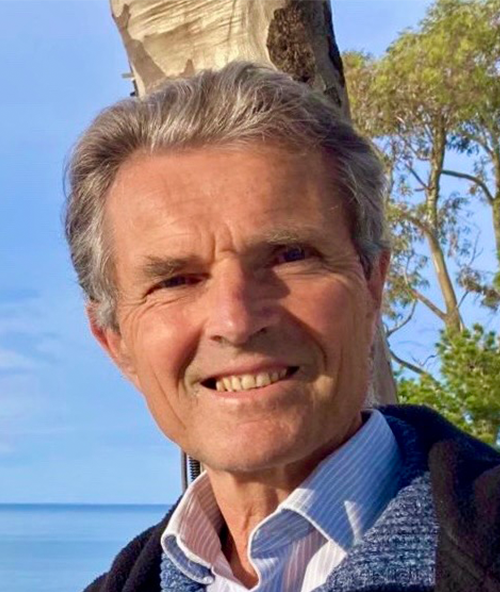
David Lorimer · Our Inner Home in the Cosmos
David Lorimer is a writer, lecturer, and editor known for his work in philosophy and education. He is the Programme Director of the Scientific and Medical Network and has authored several books on topics related to science and spirituality.
Watch the recording
Recorded Saturday 23 May, 11h30 CEST. The full transcript is available below and as a downloadable PDF.
The full session
Read the transcript
Abstract
In the second presentation of the festival's Saturday — the day given to "Our Inner Home in the Cosmos" — David Lorimer, Programme Director of the Scientific and Medical Network and convenor of the Galileo Commission, argues that our ecological and spiritual crisis is, at root, a crisis of self-image: the model we hold of the human being shapes the model we hold of the world. Dedicating the talk to the recently deceased evolutionary leader Jean Houston, he traces the long contraction of the human image — from the seventeenth-century split between primary and secondary qualities and Cartesian dualism, through the banishment of the soul, behaviourism and Dennett's "consciousness is an illusion", to transhumanism — and sets against it the older anthropology of spirit, soul, mind and body as a microcosm of the macrocosm.
The constructive half of the talk recovers the primacy of consciousness and the causal power of the inner life. Lorimer draws on William James's "filter" model of the brain and the University of Virginia's Irreducible Mind; the New Thought writers (Ralph Waldo Trine, Charles Haanel, Thomas Troward) for whom "the inner is causal"; Federico Faggin's account of consciousness as interiority and "a point of view of the indivisible one"; Goethean science and the mystics (Petrarch, Meister Eckhart); Jung's reconciliation of opposites; Teilhard de Chardin's noosphere, amorisation and Omega point; and Smuts' principle of synthesis and ideal of personality as a "supreme spiritual metaboliser". He closes on the outer consequences — grassroots agency, Smuts' and his own ancestor James Lorimer's vision of a law of nations, Robin Wall Kimmerer's "honorable harvest", Toynbee's and Havel's call for a worldwide spiritual revolution, and Peter Deunov's principles of love, wisdom and truth — summarised as the shift from the love of power to the power of love, and sealed with his poem The Spirit of Hope. A short exchange with Claudius van Wyk follows, before the panel break.
Transcript
Welcome and introduction — Michael Stock & Claudius van Wyk
Michael Stock: David Lorimer, I've had the great pleasure of listening to you online before, and I was so pleased you were able to spare the time to join us — a big welcome. You'll know something of what we have covered in the earlier three days, and so the question you're going to address, inwardness and agency in the evolution of consciousness, is central to our inquiry. Thank you. Over to Claudius.
Claudius van Wyk: David, welcome, and thank you so much for joining us. You're a writer, a lecturer, an editor known for your work in philosophy and education. You're the Programme Director of the Scientific and Medical Network, and you've authored several books on topics related to science and spirituality. We've been looking with intense eyes at the limitations of the scientific model we've been framed in — and your work has been to see how to transcend those limitations. So it is with great joy and pleasure that I invite you to address our community.
The talk — David Lorimer
David Lorimer: Thank you very much indeed. I've added a word to my title: I've added freedom, as a result of preparing this presentation and realising the centrality of it, which I'll explain as I go.
Dedication: Jean Houston
I'm dedicating this talk to Dr Jean Houston, who, as some of you may know, has just died. She was one of the prominent evolutionary leaders — Jude and I are both privileged to work in that field — and an extraordinarily visionary one, whose contribution to the culture has been matchless. She was originally mentored by Margaret Mead, and some of you may know that she literally ran into Teilhard de Chardin in New York when she was fourteen — ran straight into him on the street. They developed a close friendship, though she didn't know who he was; nobody really did at that point, because his work was not published until after he died in 1955. She called him "Monsieur Teilhard". I think that's a wonderful connection with what I'm going to be saying today.
Here are two quotations from Jean. "I firmly believe that all human beings have access to extraordinary energies and powers. Judging from accounts of mystical experience, heightened creativity, or exceptional performance by athletes and artists, we harbour a greater life than we know" — just remember that phrase, we harbour a greater life than we know — "and we need to measure up to ourselves, rather than diminish ourselves." And, very similarly: "We all have the extraordinary coded within us, waiting to be released."
The mechanistic image and its limits
Let me give a little history of philosophy and science as background to this whole image of the human being. In the seventeenth century, the great thinkers — Galileo, Descartes, Locke — came up with the distinction between primary and secondary qualities. A primary quality is what you can weigh, measure and see; a secondary quality is taste, anything subjective, and indeed consciousness. At the same time, in the 1630s, Descartes' Meditations established a Cartesian dualism between mind and matter. I read a book this week, The Rilke Lectures, which pointed out that this banishment of the soul — the middle component of human anthropology — goes back at least to 869, to one of the Councils of Constantinople. Rilke and Jung were both instrumental in bringing the soul back, as has been Anne Baring.
So the question is how to reconcile mind and matter, and what Western philosophy, science and psychology have tried to do is to assert the primacy of matter and to derive everything else from it, in an evolutionary understanding. This has been reinforced by the mechanistic metaphor — the clockwork idea Marcus was talking about last night — which still has an enormous and very limiting hold over the scientific imagination. The fundamental proposition, that organisms are mechanisms, is demonstrably false. Organisms are not mechanisms, precisely because they are organisms. It's a category error, and many of the leading people in philosophy of biology — John Dupré, and indeed Iain McGilchrist — have pointed out that we need to transcend this limiting mechanistic metaphor, which is also the computer metaphor.
Filter, not generator: the brain and consciousness
The result of this metaphor is that the brain has to give rise to the mind: matter gives rise to mind, so the brain gives rise to consciousness. William James questioned that assumption in 1898, in his Ingersoll Lecture on immortality. He pointed out three different ways you can conceive of the relationship between brain and mind. The first is that the brain produces and generates mind — the standard orthodox view in philosophy, science and psychology. The other two are that the brain is a transceiver of consciousness, or a filter — that it is either permissive or transmissive: it allows a certain form of consciousness to come through, or it acts like a radio receiver (which is, of course, another slightly mechanistic metaphor).
This has given rise to the work at the University of Virginia, in those three enormous volumes beginning with Irreducible Mind, edited by Edward Kelly. Many of us online take the view that the filter idea makes more sense, and that it also allows you to consider evidence — the kind we look at in the Galileo Commission: near-death experiences, out-of-body experiences, children who remember previous lives, terminal lucidity, after-death communications. The famous "hard problem" formulated by David Chalmers in 1995 actually incorporates the assumption that the brain gives rise to consciousness, because it asks: how does the brain generate consciousness? In our view, that's the wrong question. The question we should be asking is: what is the relationship between the brain and consciousness, without presupposing that the brain generates it?
The reduction of the human image
There has been a corresponding reduction of the human image. Iain McGilchrist, in The Matter with Things, begins with a quotation from Plotinus, the third-century Greek Neoplatonist: "But we — who are we?" That is the fundamental question. In the traditional view there was an anthropology of self, spirit, soul, mind and body — the human being as a microcosm of the macrocosm. Then there is a gradual reduction of the soul to the self, and finally even the self disappears — whereas James Hillman, like Jung and Anne Baring, is trying to bring back a psychology with a soul. Alongside this goes the desacralisation and disenchantment of the world — Max Weber's Entzauberung — which accompanies the mechanistic view.
Then you have the influence of Darwin, Freud, J. B. Watson and Skinner, and the emergence of behaviourism, which looks only at behaviour and doesn't believe consciousness and agency have any significance whatsoever. Humans are reduced to biochemical machines, hackable animals, data points, with no free will — and you get the paradoxical situation of people like the late Daniel Dennett saying that consciousness is an illusion and free will is an illusion, even though we have this sense of it all the time. It is not an adequate anthropology of what we are. Continue along this route and you get transhumanism and posthumanism. Do look at the report Harald Walach did for the Galileo Commission last year, precisely on transhumanism, because this is creeping up on us. A lot of people are happy to have implants and enhanced performance, but what goes one way can go the other: this is part of an architecture that can potentially influence the brain, thoughts and emotions, and be used for predictive policing — so that if a government picks up that you have dissident thoughts, it can brand you a heretic, or worse, a terrorist.
Self-image and world-image
Philip Sherrard, writing in the 1980s and 1990s — he was Eastern Orthodox, originally a lecturer at the University of London — wrote a book called Human Image: World Image. He says that our model of the universe, our world-picture, is based on the model we have of ourselves, on our self-image. So there is a close relationship between the two. Go back to the idea that we are machines — well, machines need to be controlled; and if we're just biochemical machines, what's the problem with merging the human with silicon machines? Our ecological and spiritual challenge therefore requires a change in both our self-image and our world-image. As Jude has been saying, we need a new way of looking at the world.
What are the metaphors we use for nature? In the Renaissance there was the idea of the world soul — Giordano Bruno, analysed in the work of Dame Frances Yates — and the idea of the world as an organism. Then came mechanism: nature as a machine, the clockwork universe of Galileo, Descartes and Newton. More recently this has been changing: the web of life and interconnectedness, Fritjof Capra's The Systems View of Life with Pier Luigi Luisi, amazingly published by Cambridge University Press; the Gaia hypothesis, where the biosphere is a self-regulating process, with Jim Lovelock and Lynn Margulis; and our original Indigenous understanding, which we are gradually regaining — that we belong to the Earth, and the Earth does not belong to us.
Here's Fritjof Capra, an honorary member of the Network: "Instead of being a machine, nature at large turns out to be more like human nature — unpredictable, sensitive to the surrounding world, influenced by small fluctuations." The appropriate way of approaching nature, to learn about her complexity and beauty, "is not through domination and control, but through respect, cooperation and dialogue." This is essential — and we're seeing the failure of domination and control on the geopolitical front right now. If you think violence will create a non-violent world, that's a ridiculous proposition. If you want a loving world, you have to put love into the world, rather than hatred, violence and division.
Worldviews, scientism and nihilism
Richard DeWitt's book Worldviews is particularly good background. His point: a worldview is "not merely a collection of separate, independent, unrelated beliefs, but an intertwined, interrelated, interconnected system of beliefs" — and it can be the basis of power. One book holding on my desk is Fabian Scheidler's The End of the Megamachine — a brilliant book; I'm talking to him on the 9th of July about it. He says we don't live in the Anthropocene, we live in the Capitalocene, the age of capitalism, because economic growth, banking and investment drive our system in a kind of perpetual motion.
If you take a doctrinaire view of your worldview, then beliefs are true and facts are correct only if they fit in — but there is no such thing as an impossible fact. If apparitions, or near-death experiences, or children remembering previous lives, actually happen, then they have to be taken seriously. You can't simply bracket them off to keep a materialistic worldview because it works well for most of what we do. This primacy of matter is taken for granted in mainstream thinking, and many philosophers and psychologists — including E. O. Wilson — are still trying to work out how it can ultimately explain everything. That leads to scientism, which is an ideology rather than science, because the underpinning materialism is simply taken for granted rather than examined as a presupposition. And it leads to nihilism — even more serious, because it means there is no meaning, no principle behind the world. It's a recipe for despair.
Consciousness within science, or science within consciousness
Look at the whole field of science and consciousness. You can either have consciousness within science or science within consciousness. The third-person, outside-in view says the brain gives rise to mind, matter is primary; it talks about neural correlates, takes a quantitative, measurable approach, and assumes the brain produces consciousness. The first-person perspective, which we all experience minute to minute, is one in which mind gives rise to matter — certainly at the phenomenal level. You can argue for the primacy of consciousness and mind, take a qualitative approach based on qualia, and hold that the brain is a filter of consciousness rather than its originator.
This is where the evidence we examine in the Galileo Commission comes in — near-death experiences, mystical experience — which in my view are gnosis and initiation. As Michael Grosso pointed out in the 1980s, people who have these experiences are effectively being initiated into the understanding that their consciousness is more than their body. They also experience the inner side of the universe as light and love, together. So it's not just a question of information, it's a question of transformation. We shouldn't fall into paranoia; we should put our energy into metanoia, into metamorphosis — as Jude says, we're in a metastrophe rather than a catastrophe.
This is summed up in two interesting quotations from inventors. Thomas Edison: "The brain is a transmitter and receiver of vibrational frequency. The human brain emits frequencies which, when focused, are picked up by other human brains and pass through the ether to affect other physical matter." And Andrew Carnegie — who took the New Thought philosophy very seriously — said that his success was at least as much mental as tactical: "You have in your head the most powerful transmitter and receiver of energy or vibration on the planet." I have a presentation called The Second Legacy of Andrew Carnegie: he gave away $350 million in his lifetime, but his second legacy, in a sense, is the primacy of consciousness and intent.
New Thought: the inner is causal
New Thought was a movement of the late nineteenth century. From Ralph Waldo Trine's In Tune with the Infinite — a text that sold two million copies between about 1898 and 1938: "The great central fact of human life is the coming into conscious realisation of our oneness with this infinite life" — oneness with this infinite life, which is flowing through each of us — "and the opening of ourselves fully to this divine inflow." It means recognising our true identity as this essential consciousness, and bringing our lives into harmony with the same great laws as all the prophets, seers and sages in the world's history. Trine says: "Each is building his own world. We both build from within, with our thoughts and feelings, and we attract from without… Thought is the force with which we build, for thoughts are forces. Like builds like and like attracts like. Everything is first worked out in the unseen before it is manifested in the seen, in the ideal before it is realised in the real, in the spiritual before it shows forth in the material." So the inner is causal; the outer manifestation is an effect. This is essential to grasp.
Charles Haanel, of the same generation, born in 1866, produced a correspondence course in 1916 called The Master Key System — an extraordinary book. He gives a very clear statement of New Thought philosophy: "There is one principle, or consciousness, pervading the entire universe. As this consciousness is omnipresent, it must be present within every individual. Each individual must be a manifestation of that omniscient, omnipotent and omnipresent consciousness. Your consciousness is therefore identical with the universal consciousness. All mind is one mind." The same was said by Walter Russell, and by Schrödinger and many of the great physicists of the 1930s. And again, Haanel: "Thoughts are causes and conditions are effects… The world without is a reflection of the world within. A majority of mankind lives in the world without; few have found the world within, yet it is the world within that makes the world without." Over a hundred years ago.
I'll mention my grandfather, Sir Robert Lorimer, a famous architect. When I'm at my desk I sit on a chair he designed, at a bureau he also designed; and if you go to Edinburgh, you must see his masterpiece, the Thistle Chapel in St Giles' Cathedral, where there's a plaque for him. Where did the bureau start? It started inside, in his imagination; then he made a drawing; then he sent the drawing to a craftsman, who made the piece out of solid oak. Look around wherever you are — lamps, books, windows, bookcases — everything you see started as an idea. It's very important to grasp and remember that.
The greatest of these New Thought thinkers, I think, is Judge Thomas Troward. "The centre of all being is also the centre of our being… Individuality is the necessary complement to universal spirit." The universal can't be individual and the individual can't be universal, yet the individual is in fact an expression of the universal. "The whole problem of life consists in finding the true relation of the individual to the universal, originating spirit… The great self-recognition is that of our relation to the Supreme Mind — that it is the generating centre, and that we are distributing centres." In his Dore Lectures he puts it: "My mind is the centre of divine operation." And he points out — this is a sub-theme of mine — that what says "I am" in me is the same as what says "I am" universally. The fundamental consciousness is manifest through each of us. Troward also insists you must bring feeling into your intent: "Desire is the creative power, the force behind all things… Desire is the mind seeking to manifest itself in some form which as yet exists only in thought." The creative process is identical at all levels of nature — plant, grow, ripen, harvest. What we plant in our subconscious is what comes up; if you plant weeds, don't expect anything but weeds.
Federico Faggin: consciousness as interiority
Now to Federico Faggin, whom I know very well — Italian-American, the originator of the Intel microprocessor some fifty years ago, a genius inventor with the US National Medal of Technology. He has written three books, the second of which is Irreducible. His key point is the distinction between direct knowing — immediate, experiential knowing, which he calls semantic, an apprehension of meaning — and indirect, symbolic knowledge, which is information. We know that we know; I know that I know. This prioritises meaning and the primacy of consciousness, because without consciousness there could be no meaning and no apprehension of information either.
Consciousness is interiority — we are experiencing it in this very moment, and we experience qualia, the felt qualities of taste and colour and the senses, which can't simply be translated; if you translate them into words you reduce them. In 1990, Faggin had an awakening: at midnight, getting himself a glass of water, he was suddenly suffused with the substance of light and love of the universe. He was it — both the experiencer and the experience — imbued with the force of truth. The universe knows itself by self-reflection: the universal can only know itself through us, through the microcosm; otherwise it would be absolute in itself, with no other. This self-recognition is a key purpose of our lives. Faggin defines himself as "a point of view of the indivisible one" — each of us a point of view of the indivisible one. He calls this a part-whole; he didn't use Koestler's word for it, which I think he should have — holon, which means exactly a part-whole. So "the I am" is my essential, universal, eternal identity — the realisation Ramana Maharshi had at sixteen, which he spent the rest of his life conveying. Faggin speaks of C-space and I-space — consciousness space, interior, and information space, exterior — indivisible; you can't have one without the other. Meaning, the right-hemispheric apprehension, is prior to the representational apprehension of the left hemisphere in Iain McGilchrist's work.
Inwardness, mysticism and Goethean science
Eva Ryder used a passage this week from Petrarch (1304–1374): "Men go about to wonder at the heights of the mountains, the mighty waves of the sea, the wide sweep of rivers, the circuit of the ocean and the revolution of the stars — but themselves they consider not," because our attention is pointed outwards. "What is the use of knowing many things if, when you have learned the dimensions of heaven and earth, the measure of the seas, the courses of the stars, the secrets of nature, you still do not know yourself?" The Delphic oracle said: know yourself, and you shall know the universe. Inwardness and interiority are of the essence of the mystical approach. A mystic is not an onlooker but a participator and co-creator, in an intrinsic relationship and expression of reality.
This onlooker consciousness — this is the work of Robert Romanyshyn — originates in the idea of perspective in art: you remove yourself from what you observe, and that mutates into scientific objectivity, impersonality, the third-person view. Goethe criticised this; in what is now called Goethean science, you need to enter into what you are contemplating and understand its process from within. When Goethe studied plants, he was interested in the metamorphosis of the plant into leaf, flower and fruit — an understanding of becoming that later gets formulated as evolution. And here is a well-known line from Meister Eckhart (who died in 1328) that I love: "The eye with which I see God is the same eye with which God sees me" — or sees in me. So subtle. Again, self-recognition, reciprocity, the I am — corresponding to the experience of cosmic consciousness, the immediate realisation that you are not a part, you are That. This is the textbook definition of gnosis. It means that we are one another, and we need to apply the golden rule. (If this were a different talk, I would explain here the significance of the life-review in the near-death experience.)
Jung: reconciling the opposites
Now to Jung, and the Mysterium Coniunctionis, the title of one of his late books. At my stage of life I find this very important — seeing how I can reconcile the opposites within myself: masculine and feminine, matter and spirit, conscious and unconscious, mind and heart, in the process of individuation. In the current issue of Paradigm Explorer I review the interview texts on which his autobiography Memories, Dreams, Reflections is based. What Jung was aiming at was wholeness, not one-sided perfection — and this begins to segue into Smuts. It's an alchemical process: the butterfly, as Jude says — the self becoming the Self, the universalisation.
This is perhaps the superconscious. In New Thought — Troward and others — there's the notion that it's not just the subconscious but the superconscious. Some of these people were studying hypnosis and genius — the mathematical prodigies who can tell you the day of the week for a date centuries ago — which in their view is a function of the superconscious: tapping directly into the universal mind. Jung also introduced synchronicity. A couple of years ago we published a volume on it called The Playful Universe, asking: what kind of reality do we live in if synchronicity happens? Most of us realise it does — it's not mere coincidence — and it shows a close relationship between inner and outer; what goes on inside us can be manifested in the outside world.
Teilhard de Chardin: the noosphere and the Omega point
Now to Teilhard de Chardin (1879–1955) — of a similar generation to Jung (1875–1961), to Walter Russell (1871–1963), and indeed to Smuts. A scientist-mystic of evolution, whose work was not published in his lifetime, moving towards the Omega point. He coined the idea of the noosphere: add thought to the biosphere and you get the noosphere — something like a metaphor for what later became the internet. There's an energy of centration, of centrogenesis, of moving towards the centre, towards inwardness, contrasted with diffusion, an outward, centrifugal energy. In French, esprit means both mind and spirit. We are coincidental with consciousness — we know it immediately, every second; it's the thing we know best, since we are it. As Jude often says, it's not something we have, it's something we are.
Spirit, for Teilhard, is not an epiphenomenon, as the materialists would have it; "the dimensions of consciousness are the dimensions of the universe itself." You have an outward, tangential flow and a magnetic, radial inflow; the axial dimension is non-local, the tangential is local — corresponding to David Bohm's implicate and explicate order (I haven't time to go into Bohm today). The radial inflow is the inwardness, the centration process — also a process of embodying love and moving towards the Omega, or Christ, point. It corresponds to Peter Deunov's idea of an outward movement of involution and a return movement of evolution to the centre; and Walter Russell had similar ideas in The Universal One (1928), of a radial energy radiating outward and a gravitational energy radiating back to the centre. Teilhard coined the word amorisation — the gradual becoming of love. He had a mystical experience of "natural psychic unity" while a stretcher-bearer in the First World War, quite similar to the way Smuts would express it. The Omega-Christ emanations are mystically perceived, at the centre of Le Milieu Divin (The Divine Milieu), the title of one of his great books; it is there that the holy presence is born and grows subtly within us, through centro-complexification. In his Christian view, this is an evolution towards Christ consciousness, the Christic. Love becomes a spiritual power and a higher agency through surrender to the divine will — and in my view the divine agency is deeper than human agency; at a certain point you develop the wish to serve the divine will, and your own agenda becomes less important. So cosmogenesis, for him, equals Christogenesis. "Love is the single higher form towards which, as they are transformed, all the other sorts of spiritual energy converge… the universe is built on the plane of union, by the forces of union." That, I think, segues nicely into Smuts' principle of synthesis.
Smuts: the principle of synthesis
I got a lot out of the earlier presentations and the texts Claudius kindly sent me. As I understand it, what Smuts describes is an immanent process within evolution — not transcendent or supernatural. There are parallels and differences between Smuts and Bergson, whose Creative Evolution came out around 1907 and was very influential, because it gave the idea that there is meaning to this unfolding creative process, and that evolution is inherently creative. (I put Tolstoy in here because Tolstoy's Christianity was a non-supernatural version — he even produced a New Testament without miracles; I think he misunderstood miracles, but he was averse to supernatural intervention. I don't know whether Smuts was aware of him.)
About the same time, Whitehead (1861–1947) — his Process and Reality, the Gifford Lectures, came out in 1928; I read it in 1983 — distinguished between the prior and consequent natures of God: the consequent nature is the evolutionary, becoming nature; the prior nature is the transcendent aspect. Transcendent being and immanent becoming. Smuts, as far as I've understood, was rather more on the side of the consequent, evolutionary nature, and against any prior transcendence — whereas I feel, with Whitehead, that we need both. The Upanishads say: "Into deep darkness fall those who follow only transcendence; into deeper darkness those who follow only immanence." So the principle of synthesis generates wholes — complexity, consciousness and unity — a progressive unity, individualisation and individuation; and the divine is the spirit of the whole, which in more modern terms one might call the principle of autopoiesis and self-organisation. These ideas of complexity, chaos and self-organisation didn't arrive until much later — they're a kind of update of what was being explained in the 1920s. And nevertheless, in spite of all that, Smuts believed in an invisible power behind, or beyond, the physical.
A short reflection on Emerson's Representative Men, which I read long ago. He writes of Plato, Swedenborg, Montaigne, Shakespeare, Napoleon and Goethe as great men and exemplars, reflecting a certain zeitgeist. Goethe is the commonality with Smuts, who had enormous regard for him — though he chose to write about Whitman rather than Goethe. I'm incredibly inspired by Goethe; Albert Schweitzer was too — he was given the Goethe Prize in 1928 and gave four lectures on him, which I reread almost every year. There are downsides to some of these men, particularly Napoleon, but Napoleon had a sense of destiny, and you can imagine the thought process on St Helena after Waterloo, where he had to weigh the significance of his life — as did Fouquet, the treasurer who built Vaux-le-Vicomte, the most powerful man in France, who spent the last seventeen years of his life in prison because his enemies got the better of him. These were thought to be drivers of progress — the idea of progress that, as Professor Jude noted, drove the scientific, technological and social advance of the nineteenth century. But the First World War broke this, and Spengler's The Decline of the West (two volumes, 1917 onward) suddenly gave the idea that civilisations and cultures are organic, going through rise and decline. I think we're seeing the decline of the US empire and ethos as we speak. Smuts argued that the world includes interiority — souls, beauty, aspirations and meaning — very similar to Faggin. The essence of Christianity, he said, is the recognition of the Christ being within all of us; and the Christ is the I Am.
Personality and inwardness
Now, personality and inwardness. A deepening inwardness leads to an enhanced agency and freedom to act — very much what Smuts was saying. "In personality, the universe is individuating as the individual is universalising." The goal of being an individual is to universalise this sense of self into the capital-S Self. Smuts writes that personality "is not only a self-restorer; it is a supreme spiritual metaboliser" — I particularly like that phrase — "which absorbs for its growth a vast variety of experience, which it creatively transmutes and assimilates for its own spiritual nourishment." An extraordinary sentence; for me it includes the role of suffering as a form of spiritual metabolism, because often our greatest sufferings are our greatest points of growth — they nourish us spiritually. And: "As an active, living whole, personality is fundamentally an organ of self-realisation" — the object of a whole is more wholeness, more of its creative self. "This means that the will, the active, voluntary nature, is its predominant element, and the intelligent or rational activity is subordinate and instrumental." A particularly interesting formulation, because there is so little emphasis on the will in our civilisation — Solzhenitsyn talks about the loss of will in his 1978 Harvard commencement address, which I strongly recommend you look up. The will has been very important to me; I'm a very disciplined person, and part of how I acquired that discipline was being a university athlete in my twenties — I was the 3,000-metre British Universities champion in 1972, and that takes an awful lot of training, and will.
Freedom as inner self-realisation
From Professor Du Pisani's notes on Wednesday, which I wanted to comment on: "Freedom is the full measure of self-realisation to which each individual aspires. To achieve freedom represents the highest achievement of which any human being is capable" — but this is an inner freedom. "The decline in freedom of thought leads to a climate of intolerance and opens the way for people to accept new tyrannies." That's exactly where we are: a decline of freedom of thought, a climate of intolerance, opening the way to accept new tyrannies. I recommend a recent interview with Mattias Desmet of the University of Ghent, with Glenn Diesen, on exactly this — mass formation. We now have an orthodox, received, consensus view on many things, such that if you don't accept it you can't be a good person — you must have evil intent. There are dissident views on many geopolitical issues that run contrary to the received narrative; the people who feel they're on the right side are "the good people", and those who disagree are "the evil people", and you then project the demonic, the shadow, onto your enemies — you can see this all around the world. "Peace, contentment and happiness are not possible without freedom. Without external freedom and internal harmony, the individual personality cannot find dignity, happiness and wholeness." Very true. Through freedom and wholeness, the individual can achieve higher spiritual values and creativeness. This is all an inner process.
From inner to outer: grassroots agency
Now I want to segue into the outer — a new hope for the future. What I want to see in the world is grassroots agency at a local level, because the powerful central institutions — and again, Marcus made this point last night — bureaucratise everything and turn it into policy. Smuts' vision for the League of Nations and the UN was really one of cooperation, partnership, synergy, mutual aid, reciprocity, fraternity, holism, and unity-in-diversity, leading to peace. My own great-grandfather, Professor James Lorimer, wrote a two-volume magnum opus, The Institutes of the Law of Nations (1883) — I have his copies, with the printer's bill inside — already proposing a permanent congress of nations and an international court of justice. He was a moral philosopher interested in the application of natural law, with honorary degrees from Moscow, Bonn and Bologna; I feel very close to him in my way of thinking.
You'll find the same principles in the work of Robin Wall Kimmerer: reciprocity, mutuality, relationship, care, partnership, kinship and belonging, leading to flourishing; abundance, generosity, giving, sharing — and the idea of an honorable harvest. You don't strip everything out; you leave something for the ducks and the animals. An honorable harvest is not a total wipeout, not 100% consumption. "Plants are those who take care of us" — think about that — and trees. And the importance of ceremony and gratitude, of thanksgiving, of place and ancestry. We've lost these rites of passage — Beltane and Samhain, the various Celtic ceremonies.
Toynbee, Havel and the spiritual revolution
Arnold Toynbee, the great historian of A Study of History, speaks to where we are: "I do not believe that the goal of true and lasting peace can be reached without a worldwide spiritual revolution… By this I mean the overcoming of self-centredness in both individuals and communities." Look at the UN: each nation still argues for its own interests, or its allies'. And how do we do it? "By getting into communion with the spiritual presence behind the universe, and by bringing our wills into harmony with it." Toynbee was a mystic — you couldn't talk about the spiritual presence behind the universe otherwise. He did the great work at Chatham House, the Royal Institute of International Affairs, publishing an annual survey of international affairs with his wife. He was a pupil at Winchester College, where I taught in the 1980s; when he was received by the school in 1974, just before his final stroke, he was addressed by the Prefect of Hall in Latin and replied in Latin — as one would, if you're a classical scholar.
I was struck by this letter of Smuts to Queen Frederica, which Claudius sent me, shortly before he died: "The mystic Whole is all the time with us and in us. One becomes aware of the divine, not as something beyond, but as the soul and essence of nature and oneself… We are truly one with all things. One realises this at great moments of inspiration, when the self merges into the Whole." Very close to the other thinkers. And here is Václav Havel, in a speech to the US Congress: "Without a global revolution in the sphere of human consciousness, nothing will change for the better in our being as humans, and the catastrophe towards which we are headed will be unavoidable… We are still incapable of understanding the only genuine backbone of our actions — if they are to be moral — which is responsibility. Responsibility to something higher than my family, my country, my firm, my success — responsibility to the order of being, where all our actions are indelibly recorded, and where, and only where, they will be judged." This is our cosmic responsibility: to understand our oneness and to act according to the golden rule.
Peter Deunov: love, wisdom and truth
Here is my teacher, Beinsa Douno — Peter Deunov — in a powerful photograph in Rila. A book I'm reading at the moment sets out three key principles. The first principle, on which the whole of existence is based, is love, which brings the impulse to life: "When I talk about love, I don't consider it as a rule in a moral sense. I talk about love as a cosmic force, as the basis and essence of life." The second principle is wisdom, which brings knowledge and light to the mind. The third is truth, which frees the human soul from bondage. (You can see I'm wearing a pentagram, which also stands for goodness and justice.) "There is nothing greater than these principles… In these principles lies the salvation of the world." The important point: this is not a belief system. Principles are principles; they need to be understood and applied. Each of us, in our own way, needs to understand love, wisdom and truth, and embody them. As Deunov sums up: "The supreme goal of human life is that people should be free, and should serve love, wisdom and truth." That's what I try to do.
This is Paneurhythmy in the Rila Mountains — a sequence of sacred dances and movements that embody the new culture: giving, reciprocity, ascending, liberation. Deunov describes four degrees of human culture, still reflected in the world today: violence — forced domination and power, as you're seeing in the Middle East; law — threat and control from the outside; justice — universal, excluding privilege (though at the moment violence is trumping justice, to coin a phrase); and love — life for the whole. The finest degree of culture is love, as Teilhard also stressed. For Deunov, love is not an emotional but an ontological power — the essence of life, a dynamic union of the separated.
From the love of power to the power of love
So the fundamental evolutionary shifts we need to make are: from fragmentation and separation to wholeness; from fear to love, kindness and trust; from competition and domination to partnership and dialogue; from greed to caring and compassion; from outer to inner authority — the inner freedom, agency and resilience we've been talking about; and from violence and force to power in David Hawkins' sense, where "force is violence and power is spiritual integrity". And from the individual to the universal, in service of the common good. Peter Deunov again, from a hundred years ago: "Humanity is moving towards collaboration, mutual aid and union. The question is knowing how to harmonise liberty and the collective… The harmonious coming-together is the higher idea of humanity, which can only be attained through life for the whole." So — love is life for the whole. Our service is life for the whole; not for the part, not even for society, but for the divine, which is the whole. The vision is the oneness of life and consciousness, awakening both the individual and the collective, and the regeneration of our Earth systems.
This sums up the necessary shift: from the love of power to the power of love. It requires an imaginative shift first. What's coming down the line from very powerful groups and elites is a "new world order" or "great reset" — based on fear, militarism, violence, separation, control, surveillance, manipulation, propaganda, exploitation, servitude and uniformity. Whereas power is based on love as the unitive principle, harmony with the Earth, fraternity, service, mutual aid, non-violence, justice, peace, life for the whole, diversity, and overcoming evil with good rather than with force.
A quotation from Peter Deunov, from a lecture in the 1930s, The Return of the Sacred Feminine — the great work of Anne Baring in her recent The Dream of the Cosmos: "Women will save the world. Not preachers, not bishops, not priests — women will save the world. The new culture does not call for women in the ordinary sense of the word, but for women of the new era — resolute, radiant women, with luminous minds, generous hearts, and willpower as strong as a diamond." There's the willpower again. And you could say it applies to men as well: we need to be radiant and resolute, with luminous minds, generous hearts, and willpower as strong as a diamond.
So this is our imperative, as I see it: to evolve into a culture of love and wisdom based on the oneness of life and the golden rule — a metaphysical and spiritual revolution; to deepen our philosophy and our ethic of love. We are living in a time of apocalypse, of revelation: the secrecy and corruption are being revealed, and need to be, for ordinary people to realise we need a completely different system, based on different principles — a politics of integrity and service, and love as life for the whole. We also need to heal our trauma, which we are creating more of by the day. We need to be grounded in love, wisdom, truth, justice, goodness and the divine will; inwardly free, centred, balanced, coherent, strong, responsible, courageous and compassionate; visionary, committed, co-creative at the causal, imaginative level. The same principles that are producing chaos can produce harmony — it's a matter of actualising it and being committed to it. As Jude and I felt at the Nordic Lighthouse gathering in Reykjavik, we need to become the kind of people who can co-create the world we all long to see. At the deepest level, I believe we simply need to manifest the light and love that we intrinsically are.
I'll leave the last word to Jean Houston: "I firmly believe we're not going to survive unless we move towards a planetary civilisation with high individuation of culture — and women have to play a critical leadership role in making this happen." We can consciously make choices for new possibilities and turn them into probabilities for our lives; we can become the co-creators of social structures that enhance life rather than diminish it.
Poem: The Spirit of Hope
Let me read my poem. It's called The Spirit of Hope. To live means to hope; poetry is the language of hope. (The opening is from a book by Byung-Chul Han.)
To hope beyond hope is to aspire to the impossible — to the not-yet-possible. To trust beyond trust, in the ditch of despair, is an orientation of the spirit, a dimension of the soul: the power of awakening, the power of resurrection, the power of rebirth. To attend to the other with love is devotion to life itself — the dawn of divine radiance, brightening the world, redeeming our motives, purifying our intent, cleansing our hearts, fortifying our courage to stand firm in the swirling turbulence with those cast adrift in the maelstrom, isolated in frigid fear. Coming into being is coming into being. Tenderly touching one another, drawing close in resonant empathy, co-creating peace from within, inspiring beauty, sowing seeds of hope in the fertile soil of cosmic spring. Dreaming forward the vision of a new Earth. Cohering in co-creative communities, coming together.
Thank you. I'm sorry — I seem to have gone on longer than I should have.
Discussion — Claudius van Wyk & David Lorimer
Claudius van Wyk: That was beautiful. What stays with me is "I am a point of view." It takes me to Empedocles, who said: God is a circle whose circumference is nowhere and whose centre is everywhere. An astonishing point of view. And it takes me to Smuts' epiphany, which will be described in the book to be published probably next month — about his formative years — where his ego boundaries dissolved and there was a sense of being at one with everything, and yet a sense of self: a self that was not limited to his physical being. He was about fifteen.
David Lorimer: [Richard Maurice] Bucke had a very similar experience — of the self universalising, and realising that the self he felt he was, was still there, yet in a universalised sense. It sounds like what Smuts experienced.
Claudius van Wyk: Yes. And the last quote — I think it was St Francis who said: what you are looking for is what is looking.
David Lorimer: Yes — or "what you're looking for is looking for you." Another reciprocity. So you don't need to go anywhere. We very much undervalue being in our culture; we value activity, doing, having, possessions, status, wealth and power. But at the end of the day, all we take with us is who we are. When we transit to the next phase, it's only who we are that we can take with us — we can't take anything else.
Claudius van Wyk: Yes. We've come to seven minutes before the hour, when we'll begin the panel discussion. I imagine there are many questions and observations that want to be asked — let's hold those until we have the whole panel in place, so we can take a biological break first. Unless there's something urgent… Shall we do that?
David Lorimer: A quick break.
Claudius van Wyk: A quick break.
© 2026 Claudius van Wyk. All rights reserved.